|
Dining Out Tips
Author:
Stan Reents, PharmD
Original Posting:
05/06/2007 06:23 AM
Last Revision: 06/25/2019 07:43 AM
 Let's face it: we don't always eat right. Let's face it: we don't always eat right.
However, it's not always our fault. Nutrition is a complicated arena. Unless you have formal training in nutrition, you will be susceptible to advertising and marketing pitches. And, the widespread availability of snacks, junk foods, drive-thru fast-food franchises, and other "convenience" foods just makes it too easy to consume unhealthy foods.
Americans now obtain one-third of their calories from restaurants and take-out meals. And, we consume more calories when dining out (Bowman SA, et al. 2004).
So, it's important to know how to make smart choices when eating at restaurants. We'll discuss that in this review. The topic of what to eat for optimum athletic performance is covered in greater detail in other Articles.
But first, let's go over some basic nutrition concepts:
NUTRITION 101: KNOW YOUR CALORIE SOURCES
There are 4 sources of calories in our diet: carbs, fats, protein, and alcohol.
Carbs and fats are your primary energy sources. Even though protein contributes to the total calorie amount of a food or beverage, protein is not really considered a major energy source. And of course, alcohol is not an essential nutrient like the other 3 are, but we need to include it in this discussion because many people overlook alcohol as a significant source of calories in their diet.
Here are the values for those calorie sources. The Atwater values are the precise scientific values (Van Horn L. 2011). However, slightly different values are used for packaged food labels:
| CALORIE SOURCE |
CALORIES PER GRAM:
FOOD LABELS |
CALORIES PER GRAM:
ATWATER VALUES |
| Fats & Oils |
9 kcal/g |
9.4 kcal/g |
| Alcohol |
7 kcal/g |
(n/a) |
| Carbohydrates |
4 kcal/g |
4.15 kcal/g |
| Protein |
4 kcal/g |
5.65 kcal/g |
| Fiber |
-0- |
(n/a) |
("kcal/g": kilocalories per gram of food; in conversation, the term "calories" is commonly used instead)
Alcohol
Keep in mind that alcohol provides 7 kcal/g compared to other dietary carbohydrates which contain only 4 kcal/g. And even though alcohol is a carbohydrate, drinking a lot of alcohol before a race does NOT qualify as "carbo loading". Alcohol is a diuretic; you don't want to be dehydrated just before a long race or athletic event. Further, some evidence shows that alcohol can impair performance for up to 14 hours after ingestion (Yesavage JA, et al. 1986).
WATCH OUT FOR CALORIE BOMBS AT RESTAURANTS!
In 2011, researchers from the USDA's Human Nutrition Research Center on Aging and Tufts University analyzed 157 meals offered at sit-down restaurants in Boston (Urban LE, et al. 2013). They found the following calorie amounts:
| RESTAURANT TYPE |
AVERAGE CALORIE AMOUNT
PER MEAL |
| • Italian Style |
1755 calories per meal |
| • American Style |
1494 calories per meal |
| • Chinese Style |
1474 calories per meal |
| • Indian Style |
1465 calories per meal |
| • Mexican Style |
1324 calories per meal |
| • Greek Style |
1233 calories per meal |
| • Thai Style |
1164 calories per meal |
| • Japanese Style |
1027 calories per meal |
| • Vietnamese Style |
922 calories per meal |
But those are just averages. Some menu choices contain way more calories than that.
We launched our innovative and award-winning "Exercise Calorie Converter" mobile app in 2010. Before that, we offered a version that ran on PDA's (remember those?!!). And we created the web-based tool in 2006. During this time, I've reviewed the menus of over 50 franchise restaurants. Here are some "calorie bombs" in each category:
Appetizers That Contain More Than 1800 Calories!
Everyone knows that desserts are going to contain a lot of sugar, a lot of fat, and lots of calories. However, at many restaurants, some appetizers contain far more calories than desserts. Of course, appetizers are often meant to be shared, but, nevertheless, watch out for these!:
| RESTAURANT |
APPETIZER |
CALORIES |
FAT (g) |
| • BJ's |
Best Beginnings
Appetizer Combo
w/Nashville Hot Sauce |
2420 kcal |
141 g |
| • Yard House |
Chicken Nachos |
2380 kcal |
154 g |
| • Longhorn Steakhouse |
Chili Cheese Fries -
large order |
2050 kcal |
129 g |
| • Outback Steakhouse |
Bloomin' Onion |
1959 kcal |
161 g |
| • Chili's |
Texas Cheese Fries -
full order |
1860 kcal |
127 g |
| • Fridays |
Jack Daniel's Sampler -
hand-breaded |
1810 kcal |
72 g |
Salads That Contain More Than 1200 Calories!
Don't assume that salads are always low in calories. Take a look at these. Note that a Big Mac from McDonalds only contains 540 calories:
| RESTAURANT |
SALAD |
CALORIES |
FAT (g) |
| • Cheesecake Factory |
Caesar Salad w/Chicken |
1510 kcal |
(n/a) |
| • California Pizza Kitchen |
Full Moroccan Spiced
Chicken Salad |
1500 kcal |
99 g |
| • Chili's |
Quesadilla Explosion
Salad |
1400 kcal |
93 g |
| • BJ's |
Honey Crisp
Chicken Salad |
1370 kcal |
103 g |
| • Maggiano's |
Chopped Salad |
1260 kcal |
115 g |
| • Fridays |
Pecan-Crusted
Chicken Salad |
1220 kcal |
84 g |
Entrees That Contain More Than 2000 Calories!
It's not hard to find dinner entrees that exceed 2000 calories. Note that 2000 calories is the number of calories that are typically recommended for an entire day for the average adult!
| RESTAURANT |
ENTREE |
CALORIES |
FAT (g) |
| • Chili's |
Crispy Honey Chipotle
Chicken Tenders w/Waffles |
2510 kcal |
125 g |
| • Macaroni Grill |
Buffalo Chicken Parmesan |
2170 kcal |
153 g |
| • Macaroni Grill |
Mama's Trio
w/Fettuccine Alfredo |
2110 kcal |
129 g |
Desserts That Contain More Than 1500 Calories!
How many calories does your restaurant meal add up to when you include one of these desserts? Like salads, desserts span a wide range of calories. When at Maggiano's, avoid the Chocolate Zuccoto Cake. Instead, their vanilla bean ice cream is only 390 calories.
| RESTAURANT |
DESSERT |
CALORIES |
FAT (g) |
| • Maggiano's |
Chocolate Zuccoto Cake |
1810 kcal |
115 g |
| • Fridays |
Red Velvet
Sparkler Cake |
1690 kcal |
92 g |
| • Applebee's |
Blue Ribbon Brownie |
1670 kcal |
78 g |
| • BJ's |
Peanut Butter
S'More Pizookie |
1580 kcal |
70 g |
| • Yard House |
Mini Trio Sampler |
1550 kcal |
92 g |
("n/a": information not available)
Yes, we've listed the highest-calorie choices in those categories above, but, stop and think how many calories you might consume at a restaurant if your meal includes the following:
- a couple beers
- bread or chips
- an appetizer
- a salad
- an entree with several side items
- dessert
A meal like this could easily exceed 3000 calories, and might even approach 4000 calories!
Now that you know a few details, here are some tips to keep in mind when you dine out...
CALORIE-REDUCING TIPS
Drink a large glass of water before starting the meal.
Doing this will give you the sense of being full. As a result, you'll eat less!
Watch out for appetizers.
Yes, most appetizers are meant to be shared, but, as the examples in the table above reveal, appetizers can often contain more calories than the main entrees.
Watch out for fats.
If the menu provides nutritional details for each item, pay special attention to the amount of fat it contains...this is often where the majority of calories come from.
Be careful what you include in your salad.
As the table above shows, some salads can contain 1500 calories. Cheese, bacon, eggs, chicken, salmon, nuts...all these add calories to a salad. Ask for the dressing on the side so that you can control the amount. And speaking of the dressing....
Avoid creamy salad dressings.
Creamy salad dressings such as bleu cheese, Caesar, ranch, and Thousand Island almost always have more calories than vinaigrette dressings. This is because they contain more fat. Opt for oil and vinegar, served in separate bottles so that you can control the amount. Only a few drops of each will give you the flavoring needed.
Carry a food reference when you dine out.
If the menu doesn't provide any nutritional details, don't try to estimate the calorie ranking of a menu item just by its name. When researchers asked people to guess the number of calories in sample restaurant meals, the responses underestimated the actual amount by as much as 600 calories.
So, to avoid menu "surprises" when dining out, carry a food reference with you. Two good ones are: Bob Greene’s Guide To Fast Food & Family Restaurants and Eating On The Run by Evelyn Tribole, MS, RD (see below).
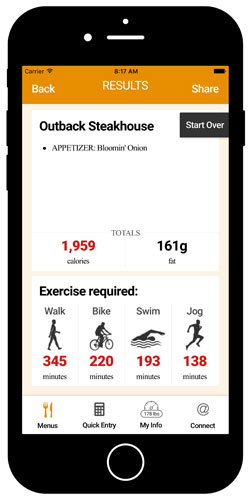
An option for those who use smart-phone apps is to purchase our Exercise Calorie Converter mobile app. Version 3.3 (released February 2018) contains more than 6000 menu items from more than 50 restaurants. In addition to providing the calorie values and amount of fat, you can convert those calorie values into minutes of exercise!
Never order anything fried.
For many menu items, the bulk of the calories is related to how it is prepared. Frying adds an enormous number of calories to some foods. A piece of fish contains about 200-300 calories, and an average potato only contains about 250 calories. However, "Fish 'n Chips" from some chain restaurants contains 2000 calories. A typical softball-sized raw onion only contains about 50 calories, but Outback Steakhouse's "Bloomin' Onion" contains 1959 calories (see screen shot of our Exercise Calorie Converter app to the right). And that's an appetizer!
Share high-calorie menu items.
It's common to share appetizers and desserts....so why not entrees? Even if a restaurant charges a sharing fee (how dumb is that?!!), be willing to pay it to get the portion size you want to avoid overeating.
...But don't match what others at your table are eating.
It's well-documented that when friends dine out together, sometimes a feeding frenzy occurs (de Castro JM, et al. 1989). Just because others at your table are raving about this or that appetizer doesn't mean you need to match them bite for bite! Resist peer pressure!
Build a meal from side items.
Stop and think for a second: do you really need an entree? If you order a salad, and several healthy side items, and nibble on an appetizer or some bread, you've probably got plenty of calories, and, a pretty healthy meal, too! Don't be afraid to ask your server if they can honor unique requests like "No entree for me....just bring me these 4 side items, please...".
Be wary of healthy-sounding names.
A Mediterranean diet is one of the healthiest ways to eat. However, just because the word "Mediterranean" is part of the name of a menu item doesn't mean it's low in calories or all that healthy. BJ's Restaurant and Brewhouse offers deep dish pizza made 14 different ways. Their "Mediterranean" style is the 2nd-highest in calories, just behind "Chicken Bacon Ranch" style. Arby's "Market Fresh" sandwiches sound great, but their "Roast Turkey and Cheddar" contains 830 calories. That's the equivalent of one-and-a-half Big Mac's from McDonalds.
Don't order dessert more often than once per month.
How boring would life be if we couldn't have dessert once in a while? I say, go ahead, but limit your splurge to no more frequently than once per month. Yes, I have cravings when I dine out, too, but I never order dessert more often than that. Think of healthy and lower-calorie options for satisfying your sweet tooth: a small dish of ice cream with either fresh berries or a couple pieces of dark chocolate is all you need. Try that instead of cake, pie, tiramisu, flan, plate-sized brownies, and other desserts loaded in calories, fat, and sugar.
HEALTHY-EATING TIPS
The tips above will help you avoid high-calorie items. Next, let's summarize some ways to make healthier choices:
Avoid foods that are fried, blackened, charred, or BBQ'd.
As discussed above, frying foods -- even low-calorie, healthy foods -- adds a huge amount of calories. But, frying introduces unhealthy elements, too. Trans fats are one. Having food blackened or charred introduces carcinogenic compounds. Simply searing meat at very high temperatures (eg., frying bacon, cooking a pepperoni pizza, etc.) causes meat to form cancer-promoting compounds called "N-nitrosamines". These compounds are known to be carcinogenic in both animals and humans (De Mey E, et al. 2017). Meat is already an unhealthy choice; these methods of cooking just make it more unhealthy.
Steaks: Order the smallest one available...or none at all.
I routinely tell people to avoid eating meat. Or, at most, only eat it several times per year. Is this the advice of a neurotic vegan? No, on the contrary. Consider what Joel Fuhrman, MD, creator of The Nutritarian Diet says: "Meat is a disease-producing food." Extensive research during the past 3 decades shows that a steady diet of meat leads to serious health problems, especially heart disease and cancer. Here are just a couple major studies:
• 1992: One of the earliest reports warning of the risks of a diet too high in meat was published in 1992 based on the ongoing Adventist Health Study in Loma Linda, California. This investigation found that men who consumed beef 3 or more times per week had a higher risk of death from coronary heart disease (Fraser GE, et al. 1992).
• 2002: In 2002, researchers in Lyon, France reported that red meat and processed meat increased the risk of colorectal cancer (Norat T, et al. 2002).
• 2005: Results from the Cancer Prevention Study II also showed that a high intake of red meat and processed meat was associated with an increased risk of colon cancer (Chao A, et al. 2005).
• 2007: In their publication Nutrition Action, CSPI stated: "People who eat more red meat -- beef, pork, and lamb -- have a higher risk of colon cancer, stomach cancer, and pancreatic cancer. And perhaps breast cancer if you're premenopausal and prostate cancer if you're African American."
• 2017: In 2017, results from the massive NIH-AARP Diet and Health Study revealed that intake of red meat increased deaths due to cancer, heart disease, diabetes, kidney disease, and liver disease (Etemadi A, et al. 2017). Also, see this superb resource from The Plantrician Project: "Quick Start Guide".
So, limit steak dinners to only several times per year and order the smallest one on the menu.
Rediscover vegetables.
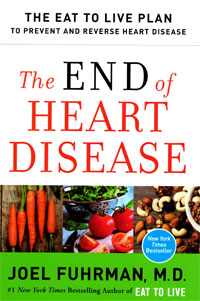
Research now shows that all forms of animal protein -- ie., not just meat -- increase your odds of developing cancer (Fontana L, et al. 2015) (Levine ME, et al. 2014). Meanwhile, a plant-based diet -- especially vegetables -- are where you get the highest number and amounts of healthy nutrients. If you really want to eat healthy, then base your meals around vegetables. Study The Nutritarian Diet by Joel Fuhrman, MD and strive to eat like that as often as you can. See: www.DrFuhrman.com. It is summarized in his superb 2016 book "The End of Heart Disease." Adjust your definition of "fine dining" from the huge steak dinner to a plate of vegetables.
Respect beans. Restrict potatoes.
The once-lowly bean is now considered one of the healthiest foods to consume regularly. Joel Fuhrman, MD, in The End of Heart Disease, points out that beans (legumes) were a consistent dietary element in a variety of cultures associated with longevity: "A 7-8% reduction in death rate was reported for every 2 tablespoons of beans eaten daily."
Dr. Fuhrman also makes a dramatic distinction between beans and potatoes:
While both are plants and both are good sources of carbohydrates and fiber, the similarity ends there. He states that beans are much higher in "resistant" starches, which behave more like fiber. Resistant starches in beans do not contribute to usable calories, and, thus, don't cause a spike in your blood glucose. Further, these resistant starches provide beneficial effects within the GI tract (ie., probiotic effects). In a table comparing the total amount of fiber+resistant starch in beans, lentils, peas, corn, rice, oats, and potatoes, beans contain the most and potatoes contain the least.
He also points out that high-glycemic index processed food promotes heart disease even more readily than saturated fats from animal products. And, when carbohydrates are exposed to high dry heat, they can form acrylamides, which are cancer-promoting compounds. So, avoid the French fries...order some beans instead!
Alcohol: Avoid hard liquor (distilled spirits).
There's no question that alcohol -- in all forms -- exerts toxic effects on a variety of organs. However, at the same time, one or two drinks per day has been shown to be beneficial for cardiovascular health. The smartest choices are red wines and hoppy and/or dark beers. Red wines contain resveratrol while hoppy and/or dark beers contain ferulic acid and xanthohumol. All 3 of these compounds are antioxidants. Hard liquors don't contain these healthy nutrients because they are lost during the distilling process. Note that one of the common behaviors researchers discovered when studying people living in 5 Blue Zones around the world was that most of them consumed red wine regularly. So, avoid distilled liquor. Instead, focus on red wine and dark/hoppy beers.
QUESTIONS
Q: Are the nutritional facts that restaurants provide accurate?
ANSWER: Regarding the nutritional information provided by restaurants, a study published in the July 20, 2011 issue of JAMA revealed that 19% of menu items studied contained at least 100 calories (kcal) more than what was reported (Urban LE, et al. 2011.) That's not a lot, but, for people who are trying to limit their calories, it could be significant. Note that an excess of 500 calories per day, every day for 7 days, will lead to a 1-lb weight gain at the end of that week.
FOR MORE INFORMATION
There are a ton of nutrition resources available. Here are several that we like:

Bob Greene’s book Guide To Fast Food & Family Restaurants (Simon & Schuster, 2004) is part of his Get With The Program series. This handy pocket-sized book (it measures 3" x 8.5") can be carried with you, or kept in the car. It provides lots of quick-reference information on restaurant chains from Applebee's to Bob Evans to Romano's Macaroni Grille to Wendy's.
Eating On The Run (Human Kinetics, 2004) by registered dietitian Evelyn Tribole, MS, RD, is an excellent resource for busy people. Even if you don't read the entire book, the 40-page fast-food data chart is worth the $16.95 price. (see Book Reviews for more information on these books).
A good resource for information on glycemic index and glycemic load is the web site www.GlycemicIndex.com maintained by the University of Sydney.
Also, don't forget to utilize our Exercise Calorie Converter. Here, you can look-up over 6000 menu selections and determine how much exercise is required to burn-off those calories. You may think twice about ordering that appetizer or dessert.
Readers may be interested in these other Articles on smart nutrition:
EXPERT HEALTH and FITNESS COACHING
Stan Reents, PharmD, is available to speak on this and many other exercise-related topics. (Here is a downloadable recording of one of his Health Talks.) He also provides a one-on-one Health Coaching Service. Contact him through the Contact Us page.
REFERENCES
Bouvard V, Loomis D, Guyton KZ, et al. Carcinogenicity of consumption of red and processed meat. Lancet Oncology 2015;16:1599-1600. Abstract
Bowman SA, Vinyard BT. Fast food consumption of US adults: impact on energy and nutrient intakes and overweight status. J Am Coll Nutr 2004;23:163-168. Abstract
Chao A, Thun MJ, Connell CJ, et al. Meat consumption and risk of colorectal cancer. JAMA 2005;293:172-182. Abstract
de Castro JM, de Castro ES. Spontaneous meal patterns of humans: influence of the presence of other people. Am J Clin Nutr 1989;50:237-247. Abstract
De Mey E, De Maere H, Paelinck H, et al. Volatile N-nitrosamines in meat products: potential precursors, influence of processing, and mitigation strategies. Crit Rev Food Sci Nutr 2017;57:2909-2923. Abstract
Etemadi A, Sinha R, Ward MH, et al. Mortality from different causes associated with meat, heme iron, nitrates, and nitrites in the NIH-AARP Diet and Health Study. Br Med J 2017;357:j1957. Abstract
Fontana L, Partridge L. Promoting health and longevity through diet: from model organisms to humans. Cell 2015;161:106-118. Abstract
Fraser GE, Sabate J, Beeson Wl, et al. A possible protective effect of nut consumption on risk of coronary heart disease. The Adventist Health Study. Arch Intern Med 1992;152:1416-1424. Abstract
Levine ME, Suarez JA, Brandhorst S, et al. Low protein intake is associated with a major reduction in IGF-1, cancer, and overall mortality in the 65 and younger but not older population. Cell Metabolism 2014;19:407-417. Abstract
Lichtman SW, Pisarska K, Berman ER, et al. Discrepancy between self-reported and actual caloric intake and exercise in obese subjects. N Engl J Med 1992;327:1893-1898. Abstract
McCrory MA, Fuss PJ, McCallum JE, et al. Dietary variety within food groups: association with energy intake and body fatness in adult men and women. Am J Clin Nutr 1999;69:440-447. Abstract
Norat T, Lukanova A, Ferrari P, et al. Meat consumption and colorectal cancer risk: dose-response meta-analysis of epidemiological studies. Int J Cancer 2002;98:241-256. Abstract
Richter CK, Skulas-Ray AC, Champagne CM, et al. Plant protein and animal proteins: do they differentially affect cardiovascular disease risk? Advances In Nutrition 2015;6:712-728. Abstract
Roberts SB, Fuss P, Heyman MB, et al. Control of food intake in older men. JAMA 1994;272:1601-1606. Abstract
Urban LE, McCrory MA, Dallal GE, et al. Accuracy of stated energy contents of restaurant foods. JAMA 2011;306:287-293. Abstract
Urban LE, Lichtenstein AH, Gary CE, et al. The energy content of restaurant foods without stated calorie information. JAMA Intern Med 2013;173:1292-1299. Abstract
Van Horn L. Calories count. But can consumers count on them? JAMA 2011;306:315-316. (no abstract)
Yesavage JA, Leirer VO. Hangover effects on aircraft pilots 14 hours after alcohol ingestion: a preliminary report. Am J Psychiatry 1986;143:1546-1550. Abstract
ABOUT THE AUTHOR

Stan Reents, PharmD, is a former healthcare professional. He is a member of the American College of Lifestyle Medicine (ACLM) and a member of the American College of Sports Medicine (ACSM). In the past, he has been certified as a Health Fitness Specialist by ACSM, as a Certified Health Coach by ACE, as a Personal Trainer by ACE, and as a tennis coach by USTA. He is the author of Sport and Exercise Pharmacology (published by Human Kinetics) and has written for Runner's World magazine, Senior Softball USA, Training and Conditioning and other fitness publications.
Browse By Topic:
fluids and electrolytes, food labels, health and fitness targets, nutrition guidelines, nutrition recommendations, sports drinks, sports nutrition
Copyright ©2026 AthleteInMe,
LLC. All rights reserved.
|