|
How to Choose a Personal Trainer
Author:
Stan Reents, PharmD
Original Posting:
05/06/2007 10:47 AM
Last Revision: 12/10/2018 05:49 AM
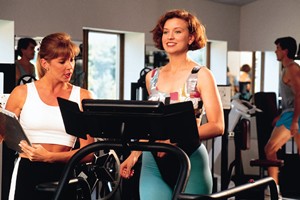 Trying to decide if you should hire a personal trainer? If so, then read this first... Trying to decide if you should hire a personal trainer? If so, then read this first...
Personal trainers can be instrumental in your overall exercise plan. A personal trainer can help you design a workout. He/she can work with you regularly motivating you through each workout.
Consider hiring a personal trainer if you:
- want to reach a specific goal
- want to update your exercise program
- need motivation
- have been inactive and feel out of shape
A qualified trainer can assess your baseline level of fitness, set goals based on that assessment, and motivate you to adhere to the program so you can reach those goals. A good program should address exercise/fitness issues, but personal trainers should not offer to design a meal program unless that trainer is also a registered dietitian (indicated by the initials "RD").
Most importantly, the program your personal trainer designs for you should, indeed, be "personalized"...ie., it should be appropriate not only for your level of fitness, but, also, it should conform to your lifestyle. For example, years ago, Oprah Winfrey hired Bob Greene as her personal trainer. He then had her running miles on Chicago roads at 5AM. For some people, getting up this early to work out, and doing it in cold weather, may not be appealing. If so, you won't stick with your exercise plan long-term.
ACADEMIC DEGREES vs. CERTIFICATION
Consider this thought for a moment: If you don't know the answer to a question, how can you be sure that the answer someone gives you is correct? Unless you are knowledgeable in health sciences, you may be in this situation when dealing with a personal trainer. For example, if a muscle-bound body-builder tells you that you need protein supplements in order to "bulk up," is he right? Not necessarily.
It is important to evaluate the education and training of the person you hire. According to Men's Health magazine, in 2009 there were over 235,000 personal trainers in the US. At that time, not a single state had any regulations requiring that personal trainers have any training or certification. Since then, several states have adopted regulation regarding the licensing of personal trainers, but still to this day, most don't address this. In 2014, the US Bureau of Labor Statistics reported that there were 279,000 fitness trainer jobs (source: www.BLS.gov).
And don't confuse certification with an academic degree. Certification is an entirely different recognition than an academic degree. For example, most physicians hold both: the MD degree is granted by a college of medicine, but becoming "board-certified" occurs several years later in a physician's training. It requires an examination-certification process that is separate from the academic program that granted the MD degree. Becoming board-certified means that physician has met the standards of practice for that discipline, eg., cardiology, gastroenterology, neurology, etc.
CERTIFICATION PROGRAMS FOR PERSONAL TRAINERS
Though not nearly as sophisticated as the medical profession, certification standards for personal trainers have gotten better over the past decade or so. Unfortunately, due to an absence of government regulation, many (too many!) certifying bodies exist. According to the American Council on Exercise (ACE) web site (accessed January 12, 2016), over 300 certification programs currently exist!
In an attempt to standardize and ensure the quality of personal trainer certification programs, an accrediting process exists. It is provided by the National Commission for Certifying Agencies (NCCA).
Your best bet is to find a trainer who is certified by one of the following groups. These are the personal trainer certification programs that have been accredited by NCCA as of January 12, 2016):
- Academy of Applied Personal Training Education
- ACTION Certification
- American College of Sports Medicine (ACSM)
- American Council on Exercise (ACE)
- Cooper Institute for Aerobics Research (CIAR)
- International Fitness Professionals Association (IFPA)
- National Academy of Sports Medicine (NASM)
- National Council on Strength & Fitness (NCSF)
- National Exercise and Sports Trainers Association
- National Exercise Trainers Association
- National Federation of Professional Trainers (NFPT)
- National Strength and Conditioning Association (NSCA)
- PTA Global
In March 2005, the International Health, Racquet and Sportsclub Association (IHRSA) adopted a resolution recommending that, beginning January 1, 2006, IHRSA clubs hire personal trainers holding at least one current certification from a certifying organization identified the National Commission on Certifying Agencies (NCCA).
In other words, not only should your personal trainer be certified, but, that certification must come from an accredited organization.
A certification by any of the groups mentioned above shows that the trainer has demonstrated basic knowledge of anatomy and physiology, exercise prescription, nutrition, and responsibility to the client. CPR certification is generally required in order to sit for these exams. Also, most of the organizations that certify personal trainers require continuing education credits every year or two to keep certification current.
Finally, be wary of certification programs that allow the individual to take the exam at home. Some fringe agencies require only a 70% or higher score even though the exam is taken at home. There is no way to ensure that the trainer in question actually took the exam.
ACADEMIC DEGREES FOR PERSONAL TRAINERS
Even better, find a personal trainer that holds an academic degree in an exercise- or health-related field. In general, if your personal trainer has earned an academic degree in kinesiology, exercise physiology, physical education or other field of exercise science or sports medicine, you will be better off than simply pumping iron with a body-builder or retired athlete. If your trainer holds an academic degree like this, he/she probably has a solid background in human anatomy, physiology, kinesiology, etc.
And years of experience in the gym is no substitute for formal academic education. In 2001, researchers at UCLA examined the knowledge of 115 fitness professionals in the areas of general training concepts, health screening, testing protocols, exercise prescription, and nutrition. They found that those who held an academic degree performed better than those who didn't (Malek MH, et al. 2002).
So, when you are considering hiring a personal trainer, try to find one with a "big brain" over the guy who simply has "big muscles."
As of April 2006, only one university, Purdue University (West Lafayette, IN) offered a 4-yr degree in personal fitness training. (Information on this program can be found at: Purdue University.)
Since then, several other academic programs have been developed:
• American Public University System (APUS) (Manassas, VA): This program offers bachelors and masters degrees in sports and health sciences with an emphasis on exercise science.
• California University of Pennsylvania (California, PA): This university offers both bachelors and masters degrees in exercise science and health promotion.
QUESTIONS TO ASK WHEN INTERVIEWING A PERSONAL TRAINER
• What academic degrees do you hold? When and from what college or university were they obtained?
• Are you certified as a personal trainer? When and from what organization did you obtain your certification?
• Are you also certified in cardiopulmonary resuscitation (CPR) and first aid?
• How long have you been providing personal training? Can you provide references from other clients?
• What health, exercise, fitness, or medical literature do you read?
• Show me how you will keep track of my progress.
• How will you ensure confidentiality of my personal health information?
• Do you have liability insurance?
• Do you sell supplements?
• What are your cancellation policies, billing procedures and any other policies?
OTHER THINGS TO CONSIDER
Some other issues you should consider include:
• Are the fees within your budget? Trainers charge a broad range of fees depending on their experience, the length of workout and location. In the US, most personal trainers charge $50-100 per hour.
• Will you have other expenses in order to carry-out the fitness plan? For example, will you have to buy free weights, a mountain bike, trail-running shoes, books, or a computer program?
• Does the trainer listen to what you want and communicate well with you? Is the trainer willing to explain the reasoning behind the plan he/she designs for you? Do you feel you will get along well with the trainer? • Is the trainer interested in helping you maintain a balanced, healthy lifestyle in addition to making you work out?
WHAT TO EXPECT FROM A PERSONAL TRAINER
During the first meeting, the trainer should explore your health history, fitness goals, and any exercise preferences. The initial interview and tests will govern the type of exercise, equipment, and level of intensity that are used. You may also be asked to complete several forms:
• Informed Consent: This should outline the benefits and risks of engaging in an exercise program and state that you accept these conditions without any deceit or coercion. It is required by law where program participants may be exposed to some type of harm, be it physical, psychological, or other.
• Health History Form: This form will contain questions regarding past and current medical problems, family history of disease, and possible risk factors which are contraindicated with exercise.
• Physician Approval: A good trainer will require written approval from a physician for males > 45 yrs, females > 55 yrs, or anyone with 2 or more risk factors for coronary artery disease. The trainer may also request this if you: are hypertensive, have diabetes, had joint-replacement, have back-pain, had surgery recently, or are pregnant. Although not absolutely required for apparently healthy individuals, it is prudent for many people to discuss new exercise plans with a knowledgeable physician.
• Fitness Assessment: Once medical clearance has been secured, the trainer may ask you to perform several tests. This may involve stretching, lifting weights, walking on a treadmill, and/or riding a stationary bicycle. A "sit-and-reach" test assesses your flexibility. Your trainer should also determine your body-mass index (BMI) from your height and weight and calculate your body-fat percentage using skinfold calipers. He/she may ask you to obtain your resting heart rate first thing in the morning before you get out of bed. With this and your age, your target exercise heart rate can be determined. These details will provide information about your baseline level of flexibility, muscular strength, muscular endurance, and cardiorespiratory endurance.
TACTICS TO AVOID
Although the majority of reputable trainers abide by a code of ethics and professional standards, some trainers may engage in unethical practices. Be highly skeptical if your trainer:
• Is hesitant to provide you with proof of credentials or references. This is probably a sign that the trainer's credentials are less than adequate.
• Says that his or her style of training is the only way to get results. Although self-confidence is a positive attribute, it is incorrect to imply that there is only one way to achieve results.
• Tries to sell you dietary supplements or even advises you to use vitamins, protein supplements, or other dubious "ergogenic aids".
• Focuses too much attention on diet and nutrition. Unless also licensed as a registered dietitian, personal trainers should not offer detailed nutrition advice.
• Is uninsured. Liability insurance is a must for every personal trainer.
• Is not punctual about appointments, or is unavailable via telephone or email. A professional trainer should be punctual and available to answer client questions.
• Is unclear about the cancellation policy. Clients have a right to know how much time they have to cancel a session in advance without being obligated to pay the fee.
• Does not keep up with current research in the field of exercise science.
• Does not practice what he/she preaches. Those who do not train their own body may lack the dedication needed to inspire their clients.
FOR MORE INFORMATION
The American College of Sports Medicine (www.ASCM.org) is the preeminent sports medicine organization in the US. They grant certifications for personal trainer, health/fitness specialist, exercise specialist, and registered clinical exercise physiologist. They have a search tool on their web site that you can use to find an ACSM-certified fitness professional: ACSM ProFinder
The American Council on Exercise is a non-profit organization founded in 1990. They have certified over 100,000 personal trainers and claim to be the largest certifying organization of personal trainers in the world. A personal trainer holding certification from ACE will: be CPR-certified, have passed a 200-question exam, and, hopefully, will have worked as a personal trainer in the industry. Their web site has a feature that helps you find an ACE-certified professional in your area (Find An ACE-Certified Professional).
The National Strength and Conditioning Association (www.NSCA-lift.org) is based in Colorado Springs, CO. It was founded in 1978 and currently has nearly 30,000 members in 52 countries.
If you're interested in becoming a personal trainer, in addition to the sites listed above, here is one with lots of relevant information: www.PersonalTrainerEDU.org.
Readers may also be interested in the following relevant stories:
EXPERT HEALTH and FITNESS COACHING
Stan Reents, PharmD, is available to speak on this and many other exercise-related topics. (Here is a downloadable recording of one of his Health Talks.) He also provides a one-on-one Health Coaching Service. Contact him through the Contact Us page.
REFERENCES
Malek MH, Nalbone DP, Berger DE, et al. Importance of health science education for personal fitness trainers. J Strength Cond Res 2002;16:19-24. Abstract
ABOUT THE AUTHOR

Stan Reents, PharmD, is a former healthcare professional. He is a member of the American College of Lifestyle Medicine (ACLM) and a member of the American College of Sports Medicine (ACSM). In the past, he has been certified as a Health Fitness Specialist by ACSM, as a Certified Health Coach by ACE, as a Personal Trainer by ACE, and as a tennis coach by USTA. He is the author of Sport and Exercise Pharmacology (published by Human Kinetics) and has written for Runner's World magazine, Senior Softball USA, Training and Conditioning and other fitness publications.
Browse By Topic:
exercise information, exercise motivation, exercise recommendations, exercise resources, health coaching, personal trainers, personal training
Copyright ©2026 AthleteInMe,
LLC. All rights reserved.
|