|
Stretching
Author:
Stan Reents, PharmD
Original Posting:
05/06/2007 11:15 AM
Last Revision: 12/10/2018 06:00 AM
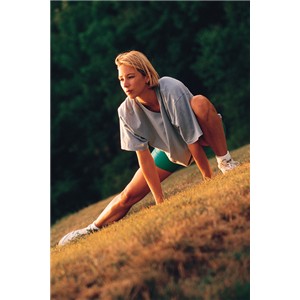 If the average person was asked to define "fitness," he/she might point to the ability to run a distance race (ie., "aerobic fitness") or the ability to lift a large amount of weight (ie., "muscular strength"). But, flexibility is a component of fitness too, even though it may not get as much attention or respect as its siblings. If the average person was asked to define "fitness," he/she might point to the ability to run a distance race (ie., "aerobic fitness") or the ability to lift a large amount of weight (ie., "muscular strength"). But, flexibility is a component of fitness too, even though it may not get as much attention or respect as its siblings.
This brings us to the concept of stretching. Almost all athletes -- from elite athletes down to the weekend warrior types -- stretch. Thus, it seems intuitive that stretching prevents injuries....why else would everybody be doing it, right?
Indeed, recent studies have shown that stretching can influence the viscosity of the tendon and make it significantly more compliant. Thus, many believe that increasing the flexibility of a muscle-tendon unit promotes better performances and decreases the number of injuries. Because of this belief, stretching is regularly included in warm-up and cooling-down exercises. However, the sports medicine literature is divided on whether stretching prevents injury.
But, before we get into the science, let's review some basics:
TYPES OF STRETCHING
To be precise, stretching can be classified into 5 different types:
• Ballistic Stretching: This is defined as: rapid lengthening (stretching) of a muscle by the use of jerking or bouncing movements, for example, bouncing down to touch your toes. This type of stretching is not recommended. In fact, it mimics the type of sudden stress that produces muscle injuries in the first place. Jerking a muscle into a full stretch causes it to lengthen beyond a safe stretch and may injure the muscle...exactly the opposite of what you are trying to achieve with stretching.
• Static Stretching: This type of stretching is characterized by a slow and sustained (eg., for 15-60 secs) lengthening of a muscle by the athlete without help from a partner. This is one of the best types of stretching because it does not pose the risk of injury to muscle and connective tissue as ballistic stretching does.
• Passive Stretching: Passive stretching is identical to static stretching, except that a partner is used to gradually move the arm or leg. The advantage of using a partner is that a greater range-of-motion can be achieved compared to stretching without a partner.
• Isometric Stretching: Isometric stretching is simply static stretching with the aid of an immovable object.
• Proprioceptive Neuromuscular Facilitation (PNF) Stretching: PNF stretching sounds more complicated than it really is. Technically, PNF stretching involves passive muscle lengthening with the use of a partner after an antagonistic muscle is contracted. PNF stretching is considered to be an excellent technic however the risk of injury is slightly greater than the other methods since the range of the stretch can be greater.
STRETCHING TO IMPROVE FLEXIBILITY: Stretching Muscles vs. Stretching Ligaments
One of the benefits of stretching is that it also improves flexibility, albeit, short-term. Stretching, combined with warming up, has been shown to increase the flexibility of the ankle, hip, and knee joints (Thacker SB, et al. 2004). However, an improvement in flexibility does not automatically mean fewer injuries or improved athletic performance. This is where there is confusion in the literature.
STRETCHING AND MUSCLE PERFORMANCE
As mentioned above, while stretching does increase the flexibility of specific joints, greater flexibility, in turn, does not always lead to improved performance. After static stretching, the muscle-tendon unit is weaker for 10-15 minutes (or longer, see below). This phenomenon has been called the "stretch lag" period, or, "tendon slack."
In fact, in some cases, stretching actually worsens (measurements of) muscle performance. Stretching has been shown to impair maximal voluntary contraction force (Behm DG, et al. 2001), muscular endurance (Kokkonen J, et al. 2001), and one-repetition maximum (Kokkonen J, et al. 1998) when it occurs just prior to the performance assessment.
A study of 40 females using a vertical jump test to assess muscle performance revealed that adding PNF stretching to a general warm-up routine worsened jumping ability (Church JB, et al. 2001).
Another study shows the effect of stretching on muscular strength over time (Fowles JR, et al. 2000). Subjects performed 13 stretches of the plantar flexors, holding each stretch for 135 seconds during a period of 33 minutes. Maximal voluntary isometric contraction (MVIC) was assessed 6 times during the ensuing 60 minutes. MVIC was depressed as follows:
ELAPSED TIME
AFTER
END OF STRETCHING |
PERCENT
STRENGTH DECREASE |
| 0 |
- 28% |
| 5 min |
- 21% |
| 15 min |
- 13% |
| 30 min |
- 12% |
| 45 min |
- 10% |
| 60 min |
- 9% |
The authors concluded that an intense prolonged stretch (of the plantar flexors) reduces maximum voluntary force for up to 1 hour after stretching.
So, this is an important principle: This research suggests that you should avoid extensive stretching for at least the hour prior to an athletic event.
STRETCHING TO PREVENT INJURIES

Contradictory findings regarding the ability of stretching to prevent injuries have been reported in the literature. Stretching recommendations are clouded by misconceptions and conflicting research reports. Apparently, no scientifically based prescription for stretching exercises exists (Witvrouw E, et al. 2004).
One fundamental issue to consider is that, even though stretching improves flexibility, most injuries occur during an extremity's normal range of motion (ie., during eccentric contraction). Thus, it is illogical to conclude that improving flexibility will prevent most muscle injuries (Shrier I. 2000).
In 1999, Shrier reviewed the literature on stretching to prevent injuries. He found 12 papers with acceptable study design. Of those, 4 showed that stretching was beneficial, 3 showed that stretching was detrimental, and 5 showed no difference (Shrier I. 1999). Obviously, this research doesn't answer the question.
Australian researchers reviewed the literature in 2002 and found that stretching had no beneficial effect on delayed-onset muscle soreness (DOMS) and did not reduce the risk of injury (Herbert RD, et al. 2002).
A subsequent literature review, published in 2004 (Witvrouw E, et al. 2004), was much more revealing. These authors proposed a possible explanation for why there is disagreement on the issue of whether stretching prevents injury:
Witvrouw and colleagues believe that the type of sports activity in which an individual is participating needs to be considered. Sports that involve a lot of bouncing and jumping activities with a high intensity of stretch-shortening cycles (SSCs) (eg. basketball, football, soccer, tennis) require a muscle-tendon unit that is compliant enough to store and release the high amount of elastic energy that benefits performance in such sports. If the muscle-tendon unit is not compliant enough, the demands in energy absorption and release may rapidly exceed its capacity. This may lead to an increased risk for injury of this structure. Thus, when a sport demands stretch-shortening cycles (SSCs) of high intensity, such as jumping or abrupt changes in direction, stretching may be important for injury prevention.
In contrast, when the type of sports activity contains low-intensity, or limited SSCs (eg. cycling, jogging, swimming), there is no need for a very compliant muscle-tendon unit since most of the forces come from active muscle contraction to generate motion. Strong evidence exists that stretching has no beneficial effect on injury prevention in these sports.
In other words, whether or not stretching prevents injury depends on the type of activity being considered.
Witvrouw and colleagues believe that if this point of view is used when examining research concerning stretching to prevent injuries, the reasons for the contrasting findings in the literature are in many instances resolved.
USE OF STRETCHING TO HASTEN RECOVERY AFTER A MUSCLE INJURY
While stretching to PREVENT an injury is not always helpful, the use of stretching to hasten recovery AFTER a muscle injury has been shown to be beneficial:
• Hamstring Injuries: A Greek study randomized athletes with hamstring strains to light stretching (once per day) or a more vigorous program (4 times per day). The study was conducted from 1996-2001 and randomized 40 athletes into each of the 2 plans. All 80 athletes received RICE (rest, ice, compression, and elevation). The stretching involved static stretching for 30 seconds per stretch session.
The authors found that normal range-of-motion was achieved earlier (5.6 days vs 7.3 days) and the time elapsed prior to achieving full athletic activity was also shorter (13.3 days vs 15 days) in the 4 times per day group compared to the once/daily group (Malliaropoulos N, et al. 2004.).
• Plantar Fasciitis: For plantar fasciitis, also known as "painful heel syndrome" or "proximal heel pain," stretching of the Achilles tendon has been shown to be beneficial in reducing pain, stiffness, and increasing range-of-motion (McNair PJ, et al. 1996; Porter D, et al. 2002). One study reported that a non-weight-bearing stretch of the plantar fascia was better than the classic standing Achilles tendon stretch (DiGiovanni BF, et al. 2003).
Thus, although it might seem counter-intuitive, stretching a strained muscle group does appear to enhance recovery.
QUESTION
Q: What about foam rollers or roller massagers? Are they helpful when I have a muscle injury?
ANSWER: Despite their widespread popularity, the published research on the effectiveness of using foam rollers and roller massagers is limited:
• Foam rollers improve range-of-motion: A study from researchers at Iowa Western Community College published in November 2014 evaluated static stretching alone, foam rollers alone, or, these 2 methods together on hip joint range-of-motion (ROM) in 40 subjects who had limited ROM in this joint. All 3 strategies improved hip joint ROM, but the use of static stretching and foam rollers together achieved the best results (Mohr AR, et al. 2014).
• Foam rollers reduce DOMS: Another study examined whether using a foam roller after a weight-lifting exercise could reduce delayed-onset muscle soreness (DOMS) and prevent a drop in muscle performance. It did. Both of these parameters were better in the subjects who used a foam roller compared to the group that didn't (MacDonald GZ, et al. 2014).
• Literature review: In 2015, researchers from Ohio State reviewed the published literature on the effectiveness of foam rollers and roller massagers. They examined 9 studies and concluded that these devices "appear" to be beneficial in improving ROM and in reducing soreness/fatigue following exercise (Schroeder AN, et al. 2015).
In our opinion, using a foam roller or roller massager may be helpful for sore or strained muscles. Also, this strategy might be preferable over traditional stretching during an athletic event if you have a sore muscle (ie., because traditional stretching seems to impair muscle performance for up to an hour afterwards).
SUMMARY
Thus, while there still is some controversy regarding stretching to prevent injury, some conclusions can be offered:
• Stretching injured muscles does appear to hasten recovery.
• Avoid ballistic stretching: It is more likely to cause injury than other stretching technics.
• Stretching to PREVENT injury is most helpful in sports that involve sudden changes of direction, such as football, soccer, or tennis or sports that require lots of jumping such as basketball or volleyball. Stretching appears to be less helpful in sports that produce less shock to the muscles, such as cycling, jogging, or swimming.
• Do not stretch extensively (if at all) within 15-60 minutes prior to a competitive event.
• If you do stretch prior to a competitive event, work that muscle group for a few minutes to help the muscle(s) recover to their normal length and power capacity. For example, if you have just stretched your hamstrings and the front of your thighs to get ready for a race, do some light jogging for several minutes before the race begins.
FOR MORE INFORMATION
 Australian triathlete Brad Walker's web site StretchCoach.com has useful resources on stretching, including an extensive library of articles and a free newsletter. Australian triathlete Brad Walker's web site StretchCoach.com has useful resources on stretching, including an extensive library of articles and a free newsletter.
A very succinct, yet thorough, review of the sports medicine literature on stretching was published in the Sept./Oct. 2002 issue of ACSM's Health and Fitness Journal (see Bracko MR, below). Although this publication is intended for sports medicine professionals, the article is written in an easy-to-understand style.
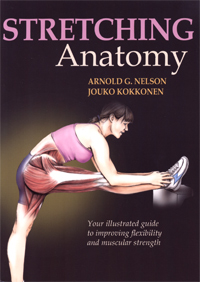
The book "Stretching Anatomy" by Nelson and Kokkonen is an academic text but demonstrates many useful stretches.
For a "how-to" book filled with diagrams, get the classic Stretching by Bob Anderson. Even though this book was originally published in 1980, it demonstrates every kind of stretch and stretching routine you can imagine.
Readers may also be interested in these topics:
EXPERT HEALTH and FITNESS COACHING
Stan Reents, PharmD, is available to speak on this and many other exercise-related topics. (Here is a downloadable recording of one of his Health Talks.) He also provides a one-on-one Health Coaching Service. Contact him through the Contact Us page.
REFERENCES
Behm DG, Button DC, Butt JC. Factors affecting force loss with prolonged stretching. Can J Appl Physiol 2001;26:261-272. Abstract
Bracko MR. Can stretching prior to exercise and sports improve performance and prevent injury? ACSM's Health and Fitness Journal 2002;6:17-22. (no abstract)
Church JB, Wiggins MS, Moode FM, et al. Effect of warm-up and flexibility treatments on vertical jump performance. J Strength Cond Res 2001;15:332-336. Abstract
DiGiovanni BF, Nawoczenski DA, Lintal ME, et al. Tissue-specific plantar fascia-stretching exercise enhances outcomes in patients with chronic heel pain. A prospective, randomized study. J Bone Joint Surg Am 2003;85-A:1270-1277. Abstract
Fowles JR, Sale DG, MacDougall JD. Reduced strength after passive stretch of the human plantar flexors. J Appl Physiol 2000;89:1179-1188. Abstract
Herbert RD, Gabriel M. Effects of stretching before and after exercising on muscle soreness and risk of injury: systematic review. BMJ 2002;325:468. Abstract
Kokkonen J, Nelson AG, Andrew C. Acute muscle stretching inhibits maximal strength performance. Res Quart Exerc Sport 1998;69:411-415. Abstract
Kokkonen J, Nelson AG, Arnall DA. Acute stretching inhibits strength endurance performance. Med Sci Sports Exerc 2001;33:11A. (no abstract)
MacDonald GZ, Button DC, Drinkwater EJ, et al. Foam rolling as a recovery tool after an intense bout of physical activity. Med Sci Sports Exerc 2014;46:131-142. Abstract
Malliaropoulos N, Papalexandris S, Papalada A, et al. The role of stretching in rehabilitation of hamstring injuries: 80 athletes follow-up. Med Sci Sports Exerc 2004;36:756-759. Abstract
McNair PJ, Stanley SN. Effect of passive stretching and jogging on the series elastic muscle stiffness and range of motion of the ankle joint. Br J Sports Med 1996;30:313-317. Abstract
Mohr AR, Long BC, Goad CL. Effect of foam rolling and static stretching on passive hip-flexion range of motion. J Sport Rehabil 2014;23:296-299. Abstract
Porter D, Barrill E, Oneacre K, et al. The effects of duration and frequency of Achilles tendon stretching on dorsiflexion and outcome in painful heel syndrome: a randomized, blinded, control study. Foot Ankle Int 2002;23:619-624. Abstract
Schroeder AN, Best TM. Is self myofascial release an effective preexercise and recovery strategy? A literature review. Curr Sports Med Rep 2015;14:200-208. Abstract
Shrier I. Stretching before exercise does not reduce the risk of local muscle injury: a critical review of the clinical and basic science literature. Clin J Sports Med 1999;9:221-227. Abstract
Shrier I. Stretching before exercise: an evidence based approach. Br J Sports Med 2000;34:324-325. Abstract
Thacker SB, Gilchrist J, Stroup DF, et al. The impact of stretching on sports injury risk: a systematic review of the literature. Med Sci Sports Exerc 2004;36:371-378. Abstract
Witvrouw E, Mahieu N, Danneels L, et al. Stretching and injury prevention: an obscure relationship. Sports Med 2004;34:443-449. Abstract
ABOUT THE AUTHOR

Stan Reents, PharmD, is a former healthcare professional. He is a member of the American College of Lifestyle Medicine (ACLM) and a member of the American College of Sports Medicine (ACSM). In the past, he has been certified as a Health Fitness Specialist by ACSM, as a Certified Health Coach by ACE, as a Personal Trainer by ACE, and as a tennis coach by USTA. He is the author of Sport and Exercise Pharmacology (published by Human Kinetics) and has written for Runner's World magazine, Senior Softball USA, Training and Conditioning and other fitness publications.
Browse By Topic:
back pain, exercise guidelines, exercise recommendations, running, sports medicine, stretching
Copyright ©2026 AthleteInMe,
LLC. All rights reserved.
|