|
Sports Creams and Topical Analgesics
Author:
Stan Reents, PharmD
Original Posting:
07/31/2007 07:04 AM
Last Revision: 07/25/2021 07:54 AM
 On April 3, 2007, Arielle Newman, a 17-year-old track and cross-country standout for Notre Dame Academy on Staten Island, NY, died in her sleep. On April 3, 2007, Arielle Newman, a 17-year-old track and cross-country standout for Notre Dame Academy on Staten Island, NY, died in her sleep.
Following a two-month investigation by the New York City medical examiner, a spokeswoman for that office stated that Newman died of salicylate toxicity. It was determined that, for relief from the typical aches and pains due to a grueling training regimen, she applied large amounts of sports creams to her legs. She died from an accidental overdose of methyl salicylate, the wintergreen-scented ingredient found in products like BenGay, Icy Hot and Tiger Balm because her body absorbed a toxic amount. How could this happen? After all, Newman was a healthy high-school athlete. And, she was using topical products that can be purchased without a prescription. "Newman put the muscle cream on her legs and used adhesive pads containing the anti-inflammatory, plus an unspecified third product," said Ellen Borakove, a spokeswoman for the medical examiner. "There were multiple products, used to great excess, and that's how she ended up with high levels. The products were used and the chemical absorbed over time, rather than from a single instance of overuse," Borakove said. Although no clear documentation exists on deaths resulting from the application of sports creams, experts said they have never heard of one other than this. Newman's death was the first of its kind in the city, authorities said. Doctors and trainers alike are perplexed by Newman's death. "This is an extremely rare and unusual case," said Eric Coris, MD, assistant professor in the University of South Florida's department of medicine in the division of sports medicine. "I've never heard of another situation like this before." Robert Sallis, MD, past president of the American College of Sports Medicine, said he has never seen an overdose of methyl salicylate by topical application in his 20 years of practice. He believes Newman could have boosted the chemical's absorption by increasing the skin's blood flow with intense exercise, or by wrapping her skin after heavily applying the ointment. But even with those methods, Sallis questions how Newman could have overdosed by simply applying it topically. "I can't imagine she was using large enough doses [of the sports cream] to go across her skin to be fatal," Sallis said. "And even if she did, she would have experienced very specific symptoms that she would have noticed long before it was potentially lethal." Coris believes there could be more to the story of Newman's death that has not been discovered, including possible dehydration. Until then, he said her death should be a warning to coaches, athletes and parents. WHAT IS "METHYL SALICYLATE"? The ingredient in the sports creams responsible for Newman's death is methyl salicylate. The common name for methyl salicylate is oil of wintergreen. Methyl salicylate is a chemical cousin of aspirin. Thus, both drugs belong to a category of antiinflammatory-analgesics known as "salicylates." However, it is very dangerous to consume methyl salicylate orally, because it is more toxic than aspirin. Yet, as the case of Arielle Newman proves, if enough methyl salicylate is absorbed through the skin, then toxicity is possible after that route of administration, too. Topical application of methyl salicylate can be hazardous if: - it is smeared over more than 40 percent of the body
- the person has a skin condition, cut, or abrasion
- an occlusive dressing or heating pad is used on the same area to which methyl salicylate was applied
- it is applied when the body temperature is elevated and the skin is flushed
- the person is using another medication -- such as the blood thinner warfarin (Joss JD, et al. 2000) -- that interacts with methyl salicylate
Absorption of Methyl Salicylate Through the Skin Methyl salicylate has the ability to penetrate the skin even without the aid of an ointment base or vehicle (Danon A, et al. 1986). And both heat and exercise can each increase the amount that is absorbed into the bloodstream: The cutaneous absorption of methyl salicylate ointment was studied in six healthy males (average age: 25 yrs) under 4 different scenarios: - at rest at 72 degrees F (22 degrees C)
- at rest at 104 degrees F (40 degrees C)
- while riding an exercise bike at 72 degrees F
- while riding an exercise bike at 104 degrees F
Exercise, in this study, consisted of cycling at 30% VO2max, which is considered "light" exercise. It was found that a hot environment and exercise can each (independently) increase the absorption of methyl salicylate from the skin. However, during the phase when the subjects exercised in a hot environment, the absorption increased 3-fold compared to at rest in a 72-degree room (Danon A, et al. 1986). It appears that several of these risk factors contributed to excessive skin absorption of methyl salicylate in the case of Arielle Newman: - the "dose" (of methyl salicylate) was excessive (ie., she was using multiple products simultaneously)
- it's possible she applied the creams / skin products after exercising, or after showering, when the skin was flushed, allowing for increased absorption
- she used the products daily, which leads to a cumulative effect
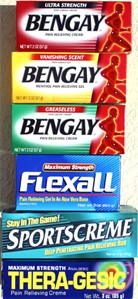
OTHER REPORTS OF TOXICITY FROM METHYL SALICYLATE CREAM As the statements above reveal, even many health care professionals aren't familiar with how readily methyl salicylate can be absorbed into the bloodstream after topical application. However, toxicity from oil of wintergreen after ingesting it orally are well-known to poison control centers, pharmacists, and most physicians. So, I visited the medical library in search of other reports of toxicity after topical application of methyl salicylate. Summarized below are 4 cases I found. (NOTE: I am not including cases involving topical application of "salicylic acid." Even though salicylic acid and methyl salicylate are related, salicylic acid is much more corrosive to human skin and is not used in sports creams.) The following cases describe salicylate toxicity occurring after the topical administration of methyl salicylate: • Salicylate level 68 mg/dl in a teenager: A teenage boy developed salicylate toxicity (salicylate level 68 mg/dl) after using BenGay while masturbating (Thompson TM, et al. 2006). • Salicylate level 52 mg/dl in a 62-year old man: A 62-year-old man developed tinnitus, blurred vision, and shortness of breath after using a methyl salicylate ointment on his thigh, twice daily, for several weeks. Blood work revealed a disruption of acid-base balance and a salicylate level of 52 mg/dl. He denied any use of aspirin or other salicylate-containing medications (Morra P, et al. 1996). • Salicylate level 48 mg/dl in a 40-year old man: In Australia, a 40-year old man developed salicylate toxicity (salicylate level 48mg/dl) after an unknown yellow cream was applied by a Chinese herbalist. In this case, the cream was applied over the entire body followed by a body wrap of plastic cling film. The patient stated that symptoms began within 1 hour and did not improve despite removing the plastic and showering 3 times over the course of the afternoon (Bell AJ, et al. 2002). • Salicylate level 41 mg/dl in a 3-month old infant: A 3-month old infant developed salicylate toxicity (salicylate level 41 mg/dl) after his mother applied "White Monkey Holding Peach Balm" topically. The label stated that it contained 3% methyl salicylate, but after analysis, it was determined the concentration was actually 5% (Smollin C, et al. 2006). All 4 of these subjects received medical treatment and survived. Remember, salicylate toxicity from topical application of methyl salicylate can be just as serious as an (oral) overdose of aspirin tablets. The warning signs of salicylate toxicity include ringing in the ears, upset stomach, agitation, rapid breathing, irregular heartbeat, dizziness, nausea and convulsions. If left untreated, this can result in heart failure, respiratory arrest and death. NOT ALL SPORTS CREAMS ARE THE SAME It's important to realize that not all sports creams are the same. Some contain methyl salicylate, while others do not. However, it's easy to get confused because some manufacturers produce different formulations using the same product name. For example: • BenGay "Ultra Strength" contains a whopping 30% methyl salicylate, whereas BenGay "Greaseless" contains a more moderate 15%, while BenGay "Vanishing Scent" contains none at all. • Icy Hot's web site (www.IcyHot.com, accessed August 16, 2019) lists 11 creams, lotions, roll-ons, and sprays, and, 7 patches and sleeves! • The web site for Tiger Balm (www.TigerBalm.com, accessed August 16, 2019) lists at least 10 different formulations, several with very similar names: Muscle Rub, Active Muscle Rub, Active Muscle Gel, Active Muscle Spray. Their "Liniment" contains 28% methyl salicylate while other formulations don't contain any. Even more confusing is Aspercreme. The name seems to imply that the active ingredient is aspirin, however aspirin is never applied directly to the skin. Salicylates, camphor, and menthol have been used for decades. More recently, capsaicin and lidocaine have also been incorporated into some OTC sports creams. The active ingredients in sports creams can be grouped into these categories:
| CATEGORY | EXAMPLE(s) | MECHANISM OF ACTION | | SALICYLATES | • methyl salicylate
• trolamine salicylate | inhibits prostaglandin synthesis | | COUNTERIRRITANTS | • camphor
• menthol | stimulates sensory signals to
override pain sensation | | LOCAL ANESTHETICS | • lidocaine | numbs the nerves involved in
pain perception | | (UNCLASSIFIED) | • capsaicin | interferes with Substance P,
a key molecule that allows
peripheral nerves to deliver
pain signals to the CNS |
Specific products and their active ingredients are listed below: Sports creams that contain METHYL salicylate:
| PRODUCT | METHYL
SALICYLATE | CAMPHOR | CAPSAICIN | MENTHOL | | • BenGay "Ultra Strength" | 30% | 4% | (none) | 10% | | • Icy Hot "Cream" | 30% | (none) | (none) | 10% | | • Icy Hot "Stick" | 30% | (none) | (none) | 10% | | • Icy Hot "Balm" | 29% | (none) | (none) | 7.6% | | • Tiger Balm "Liniment" | 28% | (none) | (none) | 16% | • Tiger Balm
"Active Muscle SPRAY" | 25% | 11% | (none) | 11% | | • Rock Sauce "FIRE" | 20% | (none) | 0.002% | 10% | • Tiger Balm
"Active Muscle GEL" | 16% | (none) | (none) | 8% | • Tiger Balm
"Active Muscle RUB" | 15% | 5% | (none) | 3% | • Tiger Balm
"Muscle RUB" | 15% | 3% | (none) | 5% | | • Arthritis Hot | 15% | (none) | (none) | 10% | | • BenGay "Greaseless" | 15% | (none) | (none) | 10% | • Thera-Gesic
"Maximum Strength" | 15% | (none) | (none) | 1% | • ThermaCare
"Ultra Pain
Relieving Cream" | 15% | 3.1% | 0.025% | 10% | | • FlexAll "Plus" | 10% | 3.1% | (none) | 16% | | • Salonpas "PATCH" | 10% | 3.1% | (none) | 6% |
Sports creams that contain TROLAMINE salicylate instead of METHYL salicylate
| PRODUCT | TROLAMINE
SALICYLATE | CAMPHOR | MENTHOL | | • Myoflex "Maximum Strength" | 20% | (none) | (none) | | • Myoflex "Extra Strength" | 15% | (none) | (none) | | • Aspercreme "Creme" | 10% | (none) | (none) | | • Aspercreme "Lotion" | 10% | (none) | (none) | | • Myoflex "Regular" | 10% | (none) | (none) | | • SportsCreme | 10% | (none) | (none) |
Sports creams that do NOT contain any salicylate (listed alphabetically by product name):
| PRODUCT | CAMPHOR | CAPSAICIN | LIDOCAINE | MENTHOL | • Aspercreme "Heat
Pain Relieving Gel" | (none) | (none) | (none) | 10% | • Aspercreme "Max
No-Mess Roll-On" | (none) | (none) | (none) | 16% | • BenGay
"Vanishing Scent" | (none) | (none) | (none) | 2.5% | | • Biofreeze | 0.2% | (none) | (none) | 3.5% | | • Capzasin-HP Creme | (none) | 0.1% | (none) | (none) | • Capzasin
"No-Mess Roll-On" | (none) | 0.15% | (none) | (none) | | • Capzasin-P Creme | (none) | 0.035% | (none) | (none) | • Capzasin
"Quick Relief Gel" | (none) | 0.025% | (none) | 10% | • Flexall
"Maximum Strength" | (none) | (none) | (none) | 16% | • Flexall
"Regular Strength" | (none) | (none) | (none) | 7% | • Icy Hot
"Advanced Relief
Cream" | 11% | (none) | (none) | 16% | • Icy Hot
"Arthritis Lotion" | 4% | (none) | (none) | 16% | • Icy Hot
"LIDOCAINE Cream" | (none) | (none) | 4% | 1% | • Icy Hot
"No Mess Roll-On" | (none) | (none) | (none) | 16% | • Icy Hot
"No Mess LIDOCAINE
Roll-On" | (none) | (none) | 4% | 1% | • Icy Hot
"Power Gel" | (none) | (none) | (none) | 16% | | • Icy Hot "Spray" | (none) | (none) | (none) | 16% | • Icy Hot
"Vanishing Scent" | (none) | (none) | (none) | 2.5% | | • Rock Sauce "ICE" | (none) | (none) | (none) | 6% | • Salonpas LIDOCAINE
"Pain Relieving Cream" | (none) | (none) | 4% | (none) | • Tiger Balm
"Arthritis Rub" | 11% | (none) | (none) | 11% | | • Tiger Balm "Extra" | 11% | (none) | (none) | 10% | • Tiger Balm
"Neck & Shoulder Rub" | 11% | (none) | (none) | 10% | | • Tiger Balm "Ultra" | 11% | (none) | (none) | 11% | • Zostrix
"Maximum Strength" | (none) | 0.1% | (none) | (none) | • Zostrix
"Original Strength" | (none) | 0.033% | (none) | (none) |
Topical Analgesic PATCHES (listed alphabetically by product name):
| PRODUCT | CAMPHOR | CAPSAICIN | LIDOCAINE | MENTHOL | • Bengay
"Pain Relieving Patch" | (none) | (none) | (none) | 5% | • Icy Hot
"Advanced Patch" | (none) | (none) | (none) | 7.5% | • Icy Hot
"Arm, Neck, and
Leg Patch" | (none) | (none) | (none) | 5% | • Icy Hot
"Back Patch" | (none) | (none) | (none) | 5% | • Icy Hot
"Back Patch XL" | (none) | (none) | (none) | 5% | • Icy Hot
"LIDOCAINE Patch" | (none) | (none) | 4% | 1% | • Icy Hot
"Micro Patch" | (none) | (none) | (none) | 7.5% | | • Icy Hot "Sleeve" | (none) | (none) | (none) | 16% | • Salonpas
"LIDOCAINE Patch" | (none) | (none) | 4% | (none) | • Tiger Balm
"Pain Relieving Patch" | 80 mg | 16 mg | (none) | 24 mg |
READ THE LABEL Experts said the death of Newman points to a need for clearer warnings about risks, especially because sports creams have become a staple in locker rooms around the country. "There has to be a heightened awareness that these products are something that needs to be used under medical supervision," said Dr.Gerard Varlotta, director of sports rehabilitation at the Rusk Institute of Rehabilitation Medicine at New York University Medical Center. The labels on both BenGay (mfr: Johnson & Johnson) and Icy Hot (mfr: Chattem Inc.) say to stop using them if "condition worsens or symptoms persist for more than 7 days." A big problem is that people don't read warning labels on over-the-counter drugs, said Rebecca Burkholder, vice president for health policy at the National Consumers League. Kimberley Rawlings, a spokeswoman for the FDA, said the agency is aware of Newman's death. "We are looking into it," she said. She would not say whether the labeling requirements for methyl salicylate products might be changed. QUESTIONS Q: It seems the obvious strategy is to not use sports creams that contain methyl salicylate. But, are "methyl salicylate-free" sports creams as effective? ANSWER: This is a good question, but, unfortunately, there isn't a lot of clinical research comparing these products head-to-head. A search of "trolamine salicylate" on PubMed conducted on August 2, 2014 retrieved only 18 publications; some of these were animal studies. Two studies compared the levels of salicylate produced by methyl salicylate and trolamine salicylate after they were applied to the skin. In one study, local tissue levels of salicylate were essentially negligible when trolamine salicylate was applied to the forearms of healthy volunteers (Cross SE, et al. 1998). In the other, the topical preparations were applied to the legs and blood levels were measured. This study also showed that methyl salicylate was superior to trolamine salicylate as the more efficient molecule for topical administration (Morra P, et al. 1996). And, not surprisingly, trolamine salicylate was regarded as ineffective when clinical effectiveness was assessed. In a study of osteoarthritis of the knee, topically-applied trolamine salicylate was no better than placebo (Algozzine GJ, et al. 1982). Thus, these studies suggest that trolamine salicylate appears to be pretty worthless when applied topically. However, 2 other studies did show that 10% trolamine salicylate cream was clinically effective: One study evaluated a single dose in patients with osteoarthritis (Rothacker DQ, et al. 1998) and the other evaluated 5 days of dosing in healthy college students using biceps curls to induce delayed-onset muscle soreness (DOMS) (Hill DW, et al. 1989). It appears that methyl salicylate is a better "salicylate delivery molecule" than trolamine salicylate. SUMMARY AND RECOMMENDATIONS "The take-home message to me is for people to realize that just because it's over the counter, just because it's a supplement, does not mean it's totally safe and that they don't have to be careful with its use," said USF's Eric Coris, MD. "We see this all the time with athletes using oral supplements. They get into trouble because they think that just because they can buy it at the local vitamin store that they can take as much of it as they want." "People are thinking if it's on the shelf at their local drugstore that it's harmless," Burkholder said. "And they're going to take as much as they need to make the pain go away." Anyone using sports creams that contain methyl salicylate should keep the following in mind: Don't overuse it. This means: - don't use it over more than 40% of your body's surface
- don't apply it in a heavy thickness
- don't use it more frequently than suggested on the label
- don't use it more than 5 days in a row
- be extra careful when using products that contain high concentrations (eg., 30%) of methyl salicylate
Remember that the absorption of methyl salicylate through the skin can be increased substantially by: - exercise
- using a heating pad or occlusive covering on the same area where the sports cream was applied
- applying it to skin that is flushed (for example, after taking a hot shower, or, sitting in a hot whirlpool)
- using it every day for 5 or more days in a row
FOR MORE INFORMATION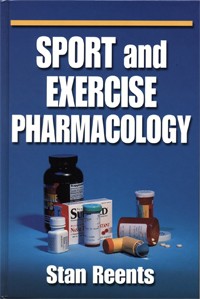 The best book for issues pertaining to drug actions during exercise is "Sport and Exercise Pharmacology," by Stan Reents, PharmD. To this day, it is still the only reference text ever published that examines the interface between drug pharmacology and exercise physiology. Readers may also be interested in these reviews: EXPERT HEALTH and FITNESS COACHING Stan Reents, PharmD, is available to speak on this and many other exercise-related topics. (Here is a downloadable recording of one of his Health Talks.) He also provides a one-on-one Health Coaching Service. Contact him through the Contact Us page. REFERENCES Algozzine GJ, Stein GH, Doering PL, et al. Trolamine salicylate cream in osteoarthritis of the knee. JAMA 1982;247:1311-1313. Abstract Bell AJ, Duggin G. Acute methyl salicylate toxicity complicating herbal skin treatment for psoriasis. Emerg Med (Fremantle) 2002;14:188-190. Abstract Brubacher JR, Hoffman RS. Salicylism from topical salicylates: Review of the literature. J Toxicol Clin Toxicol 1996;34:431-436. Abstract Chan TY. Potential dangers from topical preparations containing methyl salicylate. Hum Exp Toxicol 1996;15:747-750. Abstract Cross SE, Anderson C, Roberts MS. Topical penetration of commercial salicylate esters and salts using human isolated skin and clinical microdialysis studies. Br J Clin Pharmacol 1998;46:29-35. Abstract Danon A, Ben-Shimon S, Ben-Zvi Z. Effect of exercise and heat exposure on percutaneous absorption of methyl salicylate. Eur J Clin Pharmacol 1986;31:49-52. Abstract Hill DW, Richardson JD. Effectiveness of 10% trolamine salicylate cream on muscular soreness induced by a reproducible program of weight training. J Orthop Sports Phys Ther 1989;11:19-23. Abstract Joss JD, LeBlond RF. Potentiation of warfarin anticoagulation associated with topical methyl salicylate. Ann Pharmacother 2000;34:729-733. Abstract Morra P, Bartle WR, Walker SE, et al. Serum concentrations of salicylic acid following topically applied salicylate derivatives. Ann Pharmacother 1996;30:935-940. Abstract Roberts MS, Favretto WA, Meyer A, et al. Topical bioavailability of methyl salicylate. Aust N Z J Med 1982;12:303-305. Abstract Rothacker DQ, Lee I, Littlejohn TW. Effectiveness of a single topical application of 10% trolamine salicylate cream in the treatment of osteoarthritis. J Clin Rheumatol 1998;4:6-12. Abstract Smollin C, Wiegand T, Meier K, et al. Infant salicylism after cutaneous application of 5% methyl salicylate. Clinical Toxicology 2006;44:625-783, #296. (no abstract) Thompson TM, Lehrmann JF, Almeida E, et al. Salicylate toxicity caused by genital exposure of a methyl salicylate-containing rubefacient. Clinical Toxicology 2006;44:625-783, #191. (no abstract) ABOUT THE AUTHOR 
Stan Reents, PharmD, is a former healthcare professional. He has been a member of the American College of Lifestyle Medicine (ACLM) and a member of the American College of Sports Medicine (ACSM). In the past, he has been certified as a Health Fitness Specialist by ACSM, as a Certified Health Coach by ACE, as a Personal Trainer by ACE, and as a tennis coach by USTA. He is the author of Sport and Exercise Pharmacology (published by Human Kinetics) and has written for Runner's World magazine, Senior Softball USA, Training and Conditioning and other fitness publications.
DISCLOSURE: Neither the author, nor AthleteInMe, LLC, has any relationships or affiliations with the products or manufacturers mentioned in this review.
Browse By Topic:
back pain, sports medicine, sports pharmacology, stretching
Copyright ©2025 AthleteInMe,
LLC. All rights reserved.
|