|
Training For Distance Running: Tips For Beginners
Author:
Stan Reents, PharmD
Original Posting:
05/06/2007 11:12 AM
Last Revision: 07/23/2022 10:24 AM
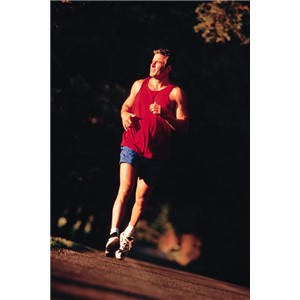 If you have never done any distance running, the following regimen will get you started. It was created by Budd Coates, a 4-time Olympic Marathon Trials qualifier and was published in Runner's World magazine and in their book Complete Book of Running. If you have never done any distance running, the following regimen will get you started. It was created by Budd Coates, a 4-time Olympic Marathon Trials qualifier and was published in Runner's World magazine and in their book Complete Book of Running.
GETTING READY First, if you are over 40 years old, or, are seriously out of shape, check with your physician before starting a new exercise routine. Next, get some good running shoes. Regardless of how fast you run, your feet will take a pounding. Running shoes have become extremely sophisticated over the past several decades and you can prevent pain and frustration by wearing shoes that are appropriate for your foot shape. The final step before you do any running, get your legs ready with 8 straight days of walking. Coates recommends walking for 20 min/day for the first 4 days, then 30 min/day for the following 4 days. RUNNING TECHNIQUE Regarding technique, many runners make contact first with their heel on each foot strike. And some may exaggerate this by running with a very long stride. There is another running technique called the "Pose" method which is characterized by: - leaning forward while running
- shorter stride lengths
- foot strikes occur more closely to the runner's center of gravity
- forefoot landing with a bent knee
- more rapid cadence
- less up-and-down oscillations of the skeleton during each stride
This running style was developed by Nicholas Romanov, PhD in 1977 when he was a university professor in the former Soviet Union (he now lives in Miami) and was summarized in the October 2004 issue of Runner's World magazine. Prior to his academic career, Romanov was a world-class high-jumper who regularly cleared 7 feet. One study revealed that there was less force transmitted into the knee joint with the "Pose" method compared to traditional heel-toe running style (Arendse RE, et al. 2004). Thus, this suggests that this running style might be associated with less knee damage. THE TEN-WEEK TRAINING PROGRAM FOR BEGINNING RUNNERS Now, you're ready to begin. Coates feels that beginning runners should focus on how long they run, not on how far. The following program is based on this concept. The strategy is to gradually increase the duration of running by alternating running and walking. Once you are able to run 30 minutes without stopping, then you can focus on increasing your distance. During each week, you should attempt to do the recommended workout 4 times. Coates recommends training on Mondays, Wednesdays, Fridays, and Saturdays, and resting the other 3 days. At any point during this training regimen, you should be running at a pace where you can still carry on a conversation. If you are breathing so hard that this is not possible, then you are running too fast for your aerobic ability. Slow down. • Week 1: Run for 2 minutes, followed by walking for 4 minutes. Repeat this cycle 4 more times (ie., for a total of 5 cycles) on your training day. In other words, the total time spent running and walking will add up to 30 minutes (6 minutes per cycle times 5 cycles). • Week 2: Run for 3 minutes, walk for 3 minutes. Complete 5 cycles. • Week 3: Run for 5 minutes, walk for 3 minutes. Complete 4 cycles. • Week 4: Run for 7 minutes, walk for 3 minutes. Complete 3 cycles. • Week 5: Run for 8 minutes, walk for 2 minutes. Complete 3 cycles. • Week 6: Run for 9 minutes, walk for 2 minutes. Complete 3 cycles. • Week 7: Run for 9 minutes, walk for 1 minute. Complete 3 cycles. • Week 8: Run for 13 minutes, walk for 2 minutes. Complete 2 cycles. • Week 9: Run for 14 minutes, walk for 1 minutes. Complete 2 cycles. • Week 10: Run for 30 minutes non-stop. At this point, you can begin to measure your training and performance in distance. Figure out how far you can run in 30 minutes. If you can run 2 miles, then try entering a fun run. Shoot for a 2-miler, or a 5-K. Your goal should be to finish without walking; at this point in your running life, forget about the time you post. Some other tips for the beginning runner are listed below. TIPS FOR THE BEGINNING RUNNER • If you are over 40 years old, seriously out of shape, have hypertension, diabetes, a heart condition, etc., don't begin any new exercise program without getting a thorough check-up from your physician. • Wear good shoes. Don't try to save money here. If you develop plantar fasciitis, even walking around the house will be painful. • If you like to train in the early morning before work, or at night when it is cooler, wear white clothing, or something that is reflective. If you run on the side of the road, run against traffic so that you can see trouble if it heads towards you. • Avoid running while wearing headphones. You're more vulnerable to cars, cyclists, dogs, and attackers. Don't run alone in remote areas. • Do some light stretching before running. • If you develop knee pain, ankle or foot pain, shin splints, a pulled muscle, or some other running-related injury, don't try to keep training. Take time to rest and recover. • Educate yourself on sports drinks. If you get to the point where you can run or exercise for an hour or more, particularly in hot climates, it will be important for you to understand the pros and cons of plain water vs. sports drinks and how much to consume. • You'll quickly learn what not to eat before running: things like dairy products, high-fiber and/or high-fat foods, and carbonated drinks will probably cause GI intolerance. But, figuring out what you should eat requires some education. FOR MORE INFORMATION Readers may also be interested in the following reviews: EXPERT HEALTH and FITNESS COACHING Stan Reents, PharmD, is available to speak on a variety of exercise-related topics. (Here is a downloadable recording of one of his Health Talks.) He also provides a one-on-one Health Coaching Service. Contact him through the Contact Us page. REFERENCES Arendse RE, Noakes TD, Azevedo LB, et al. Reduced eccentric loading of the knee with the Pose running method. Med Sci Sports Exerc 2004;36:272-277. Abstract Burfoot A (editor). Runner's World Complete Book of Running, Rodale Press, Emmaus, PA, 1997. Wallack RM. I will learn to run better. Runner's World October 2004, p. 68-73. ABOUT THE AUTHOR 
Stan Reents, PharmD, is a former healthcare professional. He is a member of the American College of Lifestyle Medicine (ACLM) and a member of the American College of Sports Medicine (ACSM). In the past, he has been certified as a Health Fitness Specialist by ACSM, as a Certified Health Coach by ACE, as a Personal Trainer by ACE, and as a tennis coach by USTA. He is the author of Sport and Exercise Pharmacology (published by Human Kinetics) and has written for Runner's World magazine, Senior Softball USA, Training and Conditioning and other fitness publications.
Browse By Topic:
aerobic exercise, exercise guidelines, exercise information, exercise recommendations, heart rate monitors, running, running shoes, stretching, treadmills
Copyright ©2026 AthleteInMe,
LLC. All rights reserved.
|