|
Measuring Fitness: Body Composition
Author:
Stan Reents, PharmD
Original Posting:
05/06/2007 10:54 AM
Last Revision: 12/10/2018 05:50 AM
 NOTE: This article is part of a 4-part series entitled "Measuring Fitness". NOTE: This article is part of a 4-part series entitled "Measuring Fitness".
ELEMENTS OF FITNESS
If asked to give an example of someone you consider "fit", would the bulked-up body-builder at your gym come to mind? While this guy may receive high marks in terms of body composition and muscular strength, it's possible he might score poorly on other aspects of fitness.
Fitness is assessed by measuring the following 5 parameters:
- cardiopulmonary (aerobic) capacity
- muscular strength
- muscular endurance
- flexibility
- body composition
And I propose that balance also be included in the assessment of fitness. (For a thorough discussion of this, see the related story "Balance: An Overlooked Element of Fitness?".)
In this discussion, I will review body composition.
BODY COMPOSITION
With regular exercise, you will probably find that, as your cardiopulmonary fitness and muscular strength improve, your body composition will also change. It's likely you will have lost fat, and lost inches around your waist and hips, and gained muscle (more so in men than women).
So, if body composition is simply a reflection of how much we exercise, maybe we should just focus on cardiopulmonary fitness and muscular strength, since they're more important, right?
Not necessarily. While it's true that aerobic capacity and muscular strength and endurance are more direct measurements of "fitness", body composition is important because of its relationship to health and disease. And, research published in 2013 suggests that, not only is the degree of obesity important (ie., measured by BMI and waist circumference), but, also, how long a person is obese is also important (Reis JP, et al. 2013).
Parameters such as body mass index (BMI), percent body fat, and waist-to-hip ratio are used to assess body composition.
BODY MASS INDEX (BMI)
Body mass index (BMI) is simply a ratio of your height to your weight. The formula is listed below:
BMI = [(wt. in pounds) divided by (ht. in inches squared)] x 703
BMI is useful because it allows for a reliable comparison of body weights among persons of different heights. For adults of average height, one BMI unit equals approximately 3.1 kg (6.9 lbs) in men and 2.6 kg (5.8 lbs) in women (Williamson DF. 1993).
The BMI values for adults are listed below (NOTE: the cut-offs for Asians differ; see "Special Populations" below):
| BMI VALUE |
CATEGORY |
| 40 and above |
morbid obesity |
| 30 - 39.9 |
obese |
| 25 - 29.9 |
overweight |
| 18.5 - 24.9 |
desirable |
| < 18.5 |
underweight |
Refer to our BMI Tables to determine your personal BMI value.
MEDICAL USES OF THE BMI VALUE
The National Institutes of Health released the BMI categories listed above in June 1998. Since then, some have criticized the 25-29 range as being too stringent. However, these BMI ranges have been shown to predict various disease states and medical conditions, including:
OBESITY INCREASES
THE RISK OF: |
Reference |
| • cancer |
Calle EE, et al. 2003 |
| • coronary artery calcification |
Reis JP, et al. 2013 |
| • coronary heart disease |
Jousilahti P, et al. 1996 |
| • gall bladder disease |
Must A, et al. 1999 |
| • heart failure |
Kenchaiah S, et al. 2002 |
| • hypertension |
Froom P et al. 1987 |
| • stroke |
Kurth T, et al. 2002 |
| • type-2 diabetes |
Must A, et al. 1999 |
As BMI values increase, so do healthcare expenses (Daviglus ML, et al. 2004).
Studies have also shown that a high BMI value is predictive of a higher rate of mortality (Calle EE, et al. 1999) (Peeters A, et al. 2003), though some research suggests that elevated BMI values are less reliable for predicting mortality in women (Dorn JM, et al. 1997) and elderly men (Stevens J, et al. 1998).
• Adolescents: Most of the research on BMI values has been conducted in adults. However, measuring body mass index during adolescence is also predictive of future health. A very large study from Norway (227,000 boys and girls ages 14-19 yrs were followed for over 30 years) shows that BMI values during adolescence were predictive of mortality in later life. Mortality was higher in the groups with the highest BMI values (Engeland A, et al. 2003). Researchers from The Netherlands evaluated over 78,000 18-year-olds and found that teenage boys with a BMI of 25 or greater had a higher rate of mortality in later life (Hoffmans MD, et al. 1988) (Hoffmans MD, et al. 1989).
LIMITATIONS OF THE BMI FORMULA
Fat vs. muscle?
One obvious flaw in the BMI formula is that it makes no distinction between fat and muscle. So, a heavily-muscled body-builder might have a BMI as high as an obese person. That's why body fat percentage and waist-to-hip ratios should also be used.
Because the BMI value does not differentiate between fat or muscle, the American Academy of Pediatrics recommends that BMI not be used in athletes (Washington RL, et al. 2005).
Special Populations
• Asians: The World Health Organization (WHO) has adopted the BMI cutoff ranges listed above, but these values are based on Western populations. At a given BMI, it has been determined that Chinese subjects have a higher amount of body fat than other races. For this group, a BMI value of 24 has been proposed as the cutoff for overweight (Wildman RP, et al. 2004).
• Children: The other limitation is that this formula should not be used in children.
BODY-FAT PERCENTAGE
Although "body mass index" (BMI) and "body fat percentage" sound alike and, in some ways, are related, in fact, they are different.
Body fat is generally expressed as a percent of total body weight. The desirable ranges of body fat for men and women are:
| GROUP |
DESIRABLE RANGE
FOR
PERCENT BODY FAT |
OBESE |
| • Men |
14 - 17% |
> 25% |
| • Women |
21 - 24% |
> 32% |
Lower limits for body fat percentage have also been established. In 1994, the average body fat percentage for sedentary college-age women was 23-27% (today, it is definitely higher!). The value for female athletes was in the range of 10-15%, and, for some athletes, such as gymnasts and distance runners, the average body fat value was as low as 8% (Agostini R, 1994). This is not to suggest that these values should be regarded as desirable. Certainly, 8% body fat is a very low value for a female and could even lead to chronic health problems.
The American Academy of Pediatrics defines "low body fat" in adolescents as < 14% for boys and < 18% for girls (Washington RL, et al. 2005).
Following the deaths of 3 college wrestlers in 1997 who were attempting to cut weight, the NCAA established a 5% body fat minimum for collegiate athletes. The National Federation of High School Associations (NFHS) also established limits for high school wrestlers (Schnirring L. 2002):
HIGH SCHOOL
WRESTLERS |
LOWEST
ACCEPTABLE VALUE |
| • Boys |
not < 7% body fat |
| • Girls |
not < 12% body fat |
To minimize health concerns, coaches and parents should reinforce the importance of not going below these limits during high school years, despite the fact that collegiate and professional athletes may do so.
In 2006, researchers at the University of New Mexico surveyed NCAA male athletes in various sports and found the following average body fat percentages:
| ATHLETE |
AVERAGE % BODY FAT |
| • Football: linemen |
17% |
| • Football: linebackers |
10% |
| • Baseball |
9% |
| • Football: quarterbacks |
6% |
| • Soccer |
5% |
| • Basketball |
5% |
• Track & Field:
jumpers & sprinters |
4% |
• Track & Field:
distance runners |
3% |
The November 2006 issue of Runner's World magazine contained a detailed comparison between cyclist Lance Armstrong and then-current marathon world-record holder Paul Tergat. Armstrong's body fat was 8% and Tergat's was 4%.
Measuring Body Fat
The most precise way to determine body fat is by a method known as underwater weighing. But, this is inconvenient.
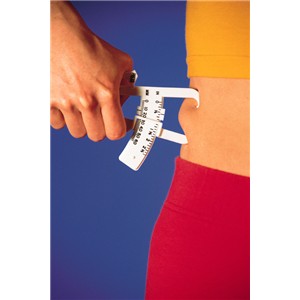
Typically, body fat is determined by measuring skin thickness (aka: skin-fold thickness, SKF) at several different sites on the body with calipers, or, with a gizmo that is based on "bioelectrical impedance." You may be familiar with how these are done, as many health clubs have their personal trainers do this for their members. In adults, SKF measurements, if taken at multiple sites on the body and done well, are nearly as good as underwater weighing (McClean KP, et al. 1992).
However, a recent study from Australia showed that skin-fold measurements are not very accurate in predicting abdominal fat or total fat in obese children and adolescents (Watts K, et al. 2006).
In 1992, Bryant and Peterson summarized the error rate of these 3 methods of determining body fat (Bryant CX, et al. 1992):
- underwater weighing: +/- 2-3%
- skin-fold assessments: +/- 5-8%
- bioelectrical impedance: +/- 5-8%
But, that was 15 years ago. Today, some manufacturers claim that their body fat analyzers have an error rate of no more than +/- 1%.
WAIST CIRCUMFERENCE
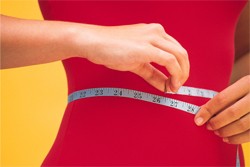 Assessing waist circumference and BMI together can provide even more predictive value than relying on BMI alone. For example, using waist circumference would help to differentiate an obese person with a high BMI from a heavily-muscled body-builder with a high BMI. In 2002, researchers from Queens University in Ontario, Canada found that subjects with a high waist circumference had a greater health risk than those who had a lower waist circumference, even though both groups had the same BMI value (Janssen I, et al. 2002). Assessing waist circumference and BMI together can provide even more predictive value than relying on BMI alone. For example, using waist circumference would help to differentiate an obese person with a high BMI from a heavily-muscled body-builder with a high BMI. In 2002, researchers from Queens University in Ontario, Canada found that subjects with a high waist circumference had a greater health risk than those who had a lower waist circumference, even though both groups had the same BMI value (Janssen I, et al. 2002).
The following ranges of waist circumference are used to predict health risk:
| RISK LEVEL |
MEN |
WOMEN |
| • High risk |
> 40 inches (102 cm) |
> 34.5 inches (88 cm) |
| • Moderate risk |
37 - 40 inches (94 - 102 cm) |
31. 5 - 34.5 inches (80 - 88 cm) |
| • Low risk |
< 37 inches (102 cm) |
< 31.5 inches (80 cm) |
WAIST-TO-HIP RATIO
Recently, the waist-to-hip ratio has been found to be an important predictor of health problems. This is a simple comparison of the circumference of the waist divided by the circumference around the hips. The values are different for men and women:
| RISK LEVEL |
MEN |
WOMEN |
| • High risk |
> 1.0 |
> 0.85 |
| • Moderate risk |
0.9 - 1.0 |
0.8 - 0.85 |
| • Low risk |
< 0.9 |
< 0.8 |
PREDICTING FUTURE HEALTH: IS BODY COMPOSITION OR AEROBIC FITNESS MORE IMPORTANT?
Even though measurements of body composition are helpful, they are not universally predictive. For example, in one study of women, when measures of body composition were compared to measures of aerobic fitness, only the level of aerobic fitness was helpful to predict future cardiovascular events (Wessel TR, et al. 2004).
Steven Blair, PED, at the University of South Carolina, has been a leading proponent for the concept "fat but fit." Blair claims his own BMI value is 32, but he runs every day.
Nevertheless, a large study of Harvard alumni showed that BMI values remained predictive even after adjusting for age and amount of physical activity (Lee IM, et al. 1993).
SUMMARY
Despite some of the limitations discussed above, measurements of body composition are still helpful for predicting future health.
Here are some recommendations:
• Set goals. Use our BMI Tables to determine a target BMI value for your height. Find a personal trainer to do body fat assessment for you. Reevaluate these measurements regularly to help you stay focused.
• Maintain a BMI of 27 or less (24 or less for Asians). If you are overweight or obese, strive to lose weight until your BMI is 27 or less. Health risks rise dramatically at BMI values above 26-27.
• Avoid extremes of body fat. Don't go crazy when attempting to lose weight. Just as too much body fat is unhealthy, so is too little. Body builders often try to get their body fat as low as possible in order to increase their muscular definition, but, in doing so, they employ some dangerous tactics, such as going without any water or fluids for 24 hours. Reducing body fat to less than 7% should never be a goal in and of itself.
DISCLAIMER: The information presented here should help you understand the clinical and scientific side of assessing fitness. You should be able to take this information and begin to map-out a fitness plan for yourself. If, however, you have asthma, cardiac disease, high blood pressure, or other chronic medical conditions, please read some of the other articles listed at AthleteInMe.com®, and, if necessary, consult with your physician before beginning anything strenuous.

FOR MORE INFORMATION
If you are serious about improving your health and fitness and want more information about the tests described above, take a look at the following books:
The American College of Sports Medicine's "Complete Guide to Fitness & Health" (editor Barbara Bushman, PhD) is a very thorough book from the leading exercise-is-good-for-your-health scientific organization in the country.
See BOOK REVIEWS for detailed summaries on books like these.
The formula for calculating BMI is explained in more detail at the Centers for Disease Control web site: www.CDC.gov.
Readers may be interested in these reviews:
BODY FAT ANALYZERS
Manufacturers of body fat analyzers include:
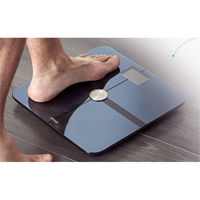
But, here is one from Withings that we think is WAY COOL!: Withings Smart Body Analyzer ($150)
Not only will it tell your body weight, but, also it reports:
- BMI
- body fat percentage
- resting heart rate
- air quality
It takes about a minute to set-up so that it interfaces with your smart phone, and then, just stand on it.
EXPERT HEALTH and FITNESS COACHING
Stan Reents, PharmD, is available to speak on this and many other exercise-related topics. (Here is a downloadable recording of one of his Health Talks.) He also provides a one-on-one Health Coaching Service. Contact him through the Contact Us page.
REFERENCES
Agostini R. Medical and orthopedic issues of active and athletic women. 1994, Hanley & Belfus, Philadelphia, PA. (no abstract)
Bryant CX, Peterson JA. How much should you weigh? Fitness Management, November 1992. p. 25-26. (no abstract)
Calle EE, Thun MJ, Petrelli JM, et al. Body-mass index and mortality in a prospective cohort of US adults. N Engl J Med 1999;341:1097-1105. Abstract
Calle EE, Rodriguez C, Walker-Thurmond K, et al. Overweight, obesity, and mortality from cancer in a prospectively studied cohort of US adults. N Engl J Med 2003;348:1625-1638. Abstract
Daviglus ML, Liu K, Yan LL, et al. Relation of body mass index in young adulthood and middle age to Medicare expenditures in older age. JAMA 2004;292:2743-2749. Abstract
Dorn JM, Schisterman EF, Winkelstein W, et al. Body mass index and mortality in a general population sample of men and women: the Buffalo Health Study. Am J Epidemiol 1997;146:919-931. Abstract
Engeland A, Bjorge T, Sogaard AJ, et al. Body mass index in adolescence in relation to total mortality: 32-year follow-up of 227,000 Norwegian boys and girls. Am J Epidemiol 2003;157:517-523. Abstract
Franks BD, Howley ET, Iyriboz Y. The Health Fitness Handbook. 1999, Chapter 7: Muscular Strength and Endurance, Human Kinetics Publishers, Champaign, IL. Abstract
Froom P, Gross M, Ribak J, et al. The predictive value of the body mass index for systolic blood pressure 12-15 years later in young air force personnel. Aviat Space Environ Med 1987;58:695-698. Abstract
Hoffmans MD, Kromhout D, et al. The impact of body mass index of 78,612 18-year old Dutch men on 32-year mortality from all causes. J Clin Epidemiol 1988;41:749-756. Abstract
Hoffmans MD, Kromhout D, Coulander CD. Body mass index at the age of 18 and its effects on 32-year mortality from coronary heart disease and cancer. J Clin Epidemiol 1989;42:513-520. Abstract
Janssen I, Katzmarzyk PT, Ross R. Body mass index, waist circumference, and health risk. Arch Intern Med 2002;162:2074-2079. Abstract
Jousilahti P, Tuomilehto J, Vartiainen E, et al. Body weight, cardiovascular risk factors, and coronary mortality. 15-yr follow-up of middle-aged men and women in eastern Finland. Circulation 1996;93:1372-1379. Abstract
Kenchaiah S, Evans JC, Levy D, et al. Obesity and the risk of heart failure. N Engl J Med 2002;347;305-313. Abstract
Kurth T, Gaziano M, Berger K, et al. Body mass index and the risk of stroke in men. Arch Intern Med 2002;162:2557-2562. Abstract
McClean KP, Skinner JS. Validity of Futrex-5000 for body composition determination. Med Sci Sports Exerc 1992;24:253-258. Abstract
Must A, Spadano J, Coakley EH, et al. The disease burden associated with overweight and obesity. JAMA 1999;282:1523-1529. Abstract
Peeters A, Barendregt JJ, Willekens F, et al. Obesity in adulthood and its consequences for life expectancy: a life-table analysis. Ann Intern Med 2003;138:24-32. Abstract
Reis JP, Loria CM, Lewis CE, et al. Association between duration of overall and abdominal obesity beginning in young adulthood and coronary artery calcification in middle age. JAMA 2013;310:280-288. Abstract
Schnirring L. Wrestling rules pin harmful weight cutting. Physician Sports Med 2002;30:7-9. (no abstract)
Stevens J, Cai J, Pamuk ER, et al. The effect of age on the association between body-mass index and mortality. N Engl J Med 1998;338:1-7. Abstract
Washington RL, Bernhardt DT, Brenner JS, et al. Promotion of healthy weight-control practices in young athletes. Pediatrics 2005;116:1557-1564. Abstract
Watts K, Naylor LH, Davis EA, et al. Do skinfolds accurately assess changes in body fat in obese children and adolescents? Med Sci Sports Exerc 2006;38:439-444. Abstract
Wessel TR, Arant CB, Olson MB, et al. Relationship of physical fitness vs body mass index with coronary artery disease and cardiovascular events in women. JAMA 2004;292;1179-1187. Abstract
Wildman RP, Gu D, Reynolds K, et al. Appropriate body mass index and waist circumference cutoffs for categorization of overweight and central adiposity among Chinese adults. Am J Clin Nutr 2004;80:1129-1136. Abstract
Williamson DF. Descriptive epidemiology of body weight and weight change in US adults. Ann Intern Med 1993;119(no.7 pt. 2):646-649. Abstract
ABOUT THE AUTHOR

Stan Reents, PharmD, is a former healthcare professional. He is a member of the American College of Lifestyle Medicine (ACLM) and a member of the American College of Sports Medicine (ACSM). In the past, he has been certified as a Health Fitness Specialist by ACSM, as a Certified Health Coach by ACE, as a Personal Trainer by ACE, and as a tennis coach by USTA. He is the author of Sport and Exercise Pharmacology (published by Human Kinetics) and has written for Runner's World magazine, Senior Softball USA, Training and Conditioning and other fitness publications.
DISCLOSURE: Neither the author, nor AthleteInMe, LLC has any relationship with any of the manufacturers of products listed here that would be considered a conflict-of-interest.
Browse By Topic:
diabetes, exercise and health, exercise guidelines, exercise recommendations, health and fitness targets, measuring fitness, obesity
Copyright ©2026 AthleteInMe,
LLC. All rights reserved.
|