|
|
Heart Rate Monitors
Author:
Stan Reents, PharmD
Original Posting:
10/05/2007 02:33 PM
Last Revision: 12/10/2018 05:46 AM
 Monitoring heart rate during (and after!) exercise is tremendously helpful. Measuring heart rate during your exercise sessions will guide you
to the most effective exercise intensity for your current level of fitness.
Elite athletes have been using heart rate monitors for decades. But, weekend warriors, and even those who just exercise for health reasons, should also consider using one. (To learn more about how you can use your heart rate to monitor your health and fitness, please see the review "Heart Rate, Exercise Intensity, and Training").
OVERVIEW OF HEART RATE MONITORS
Heart rate monitors run the gambit from simple to extremely sophisticated. Keep in mind that there are a variety of gadgets that you can wear on your wrist that monitor sports performance. In addition to simple heart rate monitors, you also have "sports watches," "running computers," and "activity monitors." You can pay as little as $29, or over $700 for one that can capture your cycling performance in addition to monitoring your heart rate. For this review, I'll focus only on heart rate monitors.
The simplest heart rate monitors do one thing: measure your heart rate. The most advanced can upload data to your PC, analyze your heart-rate data, and design custom workouts based on your performance.
Most heart-rate monitors combine a chest strap with a wristwatch display. However, some models replace the chest strap with a finger sensor:
• MIO produces a model, the MIO Ultimate, $115 (discount price October 2007), that works with or without a chest strap. This model incorporates a fingertip sensor on the watch. However, some say it's difficult to place your fingers on the sensors while working out, and the wristband is a bit stiff.
• Another brand that eliminates the chest strap is the Mark of Fitness MF-180 ($120). Instead, it uses a half-glove with a built-in finger sensor. However, the glove presents issues of its own. The finger sensor is sensitive to cold, and unless you're really working hard, it won't read your pulse when it's less than 60 degrees F outside. You also can't use this model when swimming or cycling -- so the Mark of Fitness heart-rate monitor is limited in its usefulness.
HEART RATE MONITORS BY POLAR
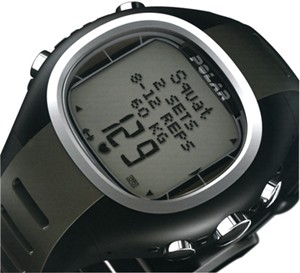 Polar was founded in 1977 by Dr. Seppo Saynajakangas, a professor at
the University of Oulu in Finland. Since he was an accomplished skier,
his country's Olympic team approached him and asked him to create a
wireless heart rate monitoring device to improve training. And that's how Polar was born. PolarUSA is a wholly owned subsidiary of Finland's Polar Electro OY. Polar was founded in 1977 by Dr. Seppo Saynajakangas, a professor at
the University of Oulu in Finland. Since he was an accomplished skier,
his country's Olympic team approached him and asked him to create a
wireless heart rate monitoring device to improve training. And that's how Polar was born. PolarUSA is a wholly owned subsidiary of Finland's Polar Electro OY.
Polar introduced the first
wireless model in 1977 and was the
only company that made heart rate monitors until the mid-1990s. Published scientific studies at the time
determined the Polar heart-rate monitor to be as accurate as an
electrocardiogram. Despite growing competition in recent years, Polar
remains the industry leader and, according to experts, still makes some
of the best heart rate monitors.
There are two batteries in each Polar heart-rate monitor: one is in the receiver (the wrist unit) and the other is in the transmitter (the chest strap). Both are guaranteed for two years. However, if the battery or any other component wears out while under warranty, you'll void your warranty if you take it to any facility besides the two authorized Polar service centers. This means you have to mail in the transmitter or receiver for the battery to be changed.
Polar markets a variety of technical gear that monitor sports performance. They categorize their devices into 4 general categories:
- FS: fitness series
- RS: running series
- CS: cycling series
- AXN: outdoor activities
Polar uses an alpha-numeric system to catalog their products. So, their "FS-1" product is a heart rate monitor of the "fitness" series. Their heart rate monitors of the RS, CS, and AXN series have additional sophisticated features and will not be included in this review. Instead, I will focus on their "F" and "FS" products, as they are mainly heart rate monitors.
The Polar FS-series: the "fitness" series
As stated above, Polar's FS products represent their "fitness series." You might refer to them as their "fun and simple" products because they are much less complicated than their other product lines. All of the heart rate monitors of the F/FS series require a chest strap and are water resistant. A higher number means more features (and a higher price) over a product with a lower number.
• FS-1, FS-2, FS-3: These 3 heart rate monitors are their most basic models. They are very similar, with each higher number representing one or two added features over a lower numbered product. All 3 compute average HR and exercise time and are water resistant to 50 meters. The list price for these range $63-84 (as of October 2007).
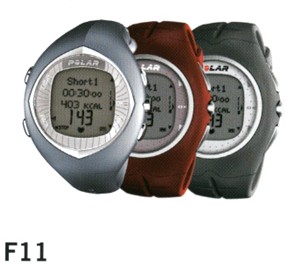
• F-4, F-6: These models have several additional features, such as the ability to calculate calories burned ("Own Cal") and a visual display that shows where your HR is in relation to your desired target zone ("Zone Pointer"). These are nice features. These models list for $95 and $155, respectively (as of October 2007).
• F-11, F-55: The F-11 and the F-55 are the most sophisticated models in the fitness series. Both include all the features of the lower models, but both the F-11 and the F-55 can develop a personalized fitness program based on your current fitness level, your fitness goal, and your available time to exercise. Polar calls this their "Keeps U Fit" program. The F-11 lists for $169, while the F-55 lists for $229 (as of October 2007). Both can support 5 different languages.
HEART RATE MONITORS BY SUUNTO
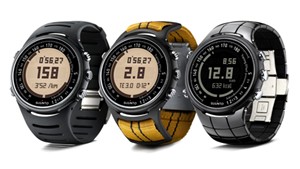
SUUNTO makes some of the most sophisticated heart rate monitors on the market today.
RECOMMENDED HEART-RATE MONITORS
Are there any objective evaluations of heart-rate monitors?
In October 2005, the web site ConsumerSearch.com reviewed heart rate monitors. Obviously, this is now old data, but, here are the ratings:
Models from nine manufacturers were each used at least once during workouts by five men and four women. Heart-rate monitors were then rated for accuracy and ease of use. They included models that serve both the beginning and more advanced exerciser. Some of the models they recommended are listed below:
• Best basic heart-rate monitor: Acumen Eon Basix ES ($55)
The Acumen Eon Basix ES is easy to use and doesn't have
a lot of extra functions to confuse novices. At the time, it was a top pick of Prevention
magazine. The Acumen heart-rate monitor includes an in-zone goal
countdown timer, an easy-to-set-up target zone function with audible
and visual alarms, and a calorie counter. The Basix has a scratch resistant crystal lens and an easy-to-read display. Unlike Polar heart-rate
monitors, the batteries are user-replaceable. The Acumen is
water-resistant up to 30 meters. There's also a women's version,
designed to fit a woman's smaller wrists and torso. The Acumen Eon
Basix ES is ranked as Tops for Beginners, so
if you're not technically inclined and you're looking for just the
basics in a heart-rate monitor, the Basix may be for you. The Acumen Eon Basix Plus ($75) is a higher-end version of
the Eon Basix ES heart-rate monitor.
• Best heart-rate monitor overall: Polar F-11 ($150)
Polar's F-11 heart-rate monitor has received a lot of positive reviews. Its "Keeps U Fit Workout Program" can be tailored to your personal goals, "OwnZone" keeps you in your target heart-rate zone, and "OwnCal" allows you to track calories consumed. The Polar F-11 uses a coded transmitter to detect your heart rate, eliminating interference from other nearby heart-rate monitors. USA Today and Men's Fitness gave a
nod to the Polar F-11 heart-rate monitor.
Prevention magazine ranked the CardioSport Go 10 ($70) as its favorite model overall, saying the monitor is easy to set up and read because it provides only the essentials: Maximum, minimum, and average heart rate, out-of-zone alarms, a timer and feedback control. Another advantage of this heart-rate monitor is a user-replaceable battery on the chest strap. About.com likes the CardioSport Go 20 ($80), which is advertised as a women's model designed to fit a smaller wrist, as one of the best monitors under $100. The Go 20 heart-rate monitor includes a countdown timer (the Go 10 skips this feature), stopwatch, alarm, and time/day readout. While CardioSport's Go heart-rate monitors appear to be good basic models, more reviews chose the Polar A-3 as the best basic monitor (Editorial note: Polar has since discontinued their "A-series" of heart rate monitors. Instead, shoppers should consider models of
"F" or "FS" series.)
• Best heart-rate monitor with GPS: Garmin Forerunner 301 ($300)
The Garmin Forerunner 301 is pricey, but that's because it has global positioning system (GPS) navigation ability, which tells you how far and how fast you're going. It can even give you directions home when you've finished your workout. The Garmin GPS heart-rate monitor also comes with PC-based software so you can analyze and create your workouts. It has a 14-hour rechargeable lithium ion battery, sport-based heart-rate profile, and an AutoLearn function, which adjusts your heart rate zone as your fitness improves, and a host of other "smart" functions.
Reviews say the Forerunner 301 heart-rate monitor is lightweight and easy to use. Like the Polar F-11, the Garmin uses coded transmission to eliminate interference. The Forerunner is not designed for continuous underwater use.
WIRELESS TECHNOLOGY USED IN HEART RATE MONITORS
Wireless connectivity is a cool thing.....IF you know how to use it!
At the time I am writing this (January 2015), it appears there are 2 main wireless technologies used in heart rate monitors:
• "ANT+"
• "Bluetooth Smart"
Both are wireless technologies, and, both use radio waves to achieve that. But, there are some distinct differences and these details may influence which device you purchase. Here is a brief comparison:
| DETAILS: |
ANT+ |
BLUETOOTH SMART |
| • Owned by: |
Garmin
(chips made by
Texas Instruments) |
BlueTooth |
| • Technology: |
radio waves |
radio waves |
• Major Mfrs That
Use It: |
• Garmin
• Nautilus |
• Apple
• Samsung |
| • Comments: |
Current usage is mostly
limited to fitness devices
like HR monitors |
Very new, so
fewer devices use this
compared to
ANT+ or
traditional BlueTooth |
HEART RATE MONITORS WITH SPECIFIC FEATURES
- HRMs that "talk": If you want a HRM that "talks", consider Oregon Scientific's AH-300E or AH-310E.
- HRMs for smaller wrists/torsos: Look for models that are marketed to women, such as the Acumen Eon Basix ES.
- HRMs without a chest strap: Consider the Mark Of Fitness MF-180, the MIO Ultimate, or the Reebok CardioSport Go 10-S.
- HRMs that are water resistant: Most of the Polar and Suunto HRMs are water resistant. Some of the Garmin units are not (see below).
RECOMMENDATIONS FROM A TRIATHLETE
I asked a triathlete friend which HRMs he liked. Listed below is his answer:
(from: Chris S., Tampa, FL, August 2007): "I use 2 different heart rate monitors. The main one is a Polar 610i. Unfortunately this model has been discontinued, but I like it a lot. Polar HRM's have been very reliable for me. The display is large and easy to read. It can record and save your workouts which you can then upload to your computer. If you're real analytical about your data, you can get a good idea of your heart rate training zones. When you set up the watch you can input your information like height, weight, age, sex, max. heart rate, and VO2max (if you know it). You can also do a fitness test to determine your resting heart rate which will help determine your training zones. If you like interval training, you can program several different exercises. This is a good multisport watch. The biggest downfall of Polar HRM's is the fact that you have to send them back to Polar to change the battery or else the warranty is void. So, I've been without it for a couple of weeks while they're replacing the battery. Other than that, it's a very good HRM."
"They make other multisport watches which you can use on the bike and get information like cadence, power, and speed. Their RS line of watches are good running specific watches."
"The other watch I use is a Garmin Forerunner 301.This is a heart rate monitor with a GPS. This HRM has a ton of options, and you can customize the screens to your own liking. This watch does have a few downfalls though. The first is the size. I have an earlier model which is bulky. They've recently changed that but it’s still kind of big."
"Second, it's not waterproof, so swimming with it is out of the question."
"Third, the heart rate monitor isn't as reliable as Polar's."
"Fourth, on the back of the watch there is a USB port which you use to charge the battery and upload your information to your computer. The USB port can become corroded from sweat. There is a tiny rubber cover to help protect it, but it doesn't work very well. The battery life is only about 13 hours so you constantly have to charge it. I tried to use it during an Ironman race, but it failed before I finished the run, and I was easily under 13 hours when it died. They have replaced this watch within the last year or so with the Garmin Forerunner 305, so a lot of these issues have been fixed. I had returned the watch to the manufacturer to fix some of these things and they gave me a new watch so their customer service is good. The GPS function is very good. It gives you very detailed information and like I said earlier you can customize the screens to your liking. This is also a good multisport watch which you can you use if you're doing a bike-run workout. It will switch from recording your bike data to recording your run data."
"So both watches have their pluses and minuses. The Polar is more reliable as a heart rate monitor than the Garmin, but the Garmin provides a ton more information for analyzing your workouts. Sometimes though I find myself being fixated on the watches while I'm working out, trying to make sure I'm at a certain heart rate or certain pace. That can sometimes take away from the actual workout." QUESTIONS
Q: Polar claims their S-810i model can determine my VO2max value within 92% accuracy. Is there any evidence to back this up?
ANSWER: The March 2006 issue of National Geographic's Adventure magazine summarizes an evaluation by one of their editors. First, the editor had his VO2max measured on a treadmill in a sports lab in Irvine, CA: 53.5 ml/kg/min. Then, he tested the Polar S-810i four times over the next 2 weeks and each time it provided a reading of 52 ml/kg/min, even better than Polar's claimed accuracy. That's pretty impressive.
SUMMARY AND GUIDELINES
Heart rate monitors are serious fitness-training tools that have trickled down from the athletic elite to the exercising public. More and more amateur exercisers are using heart-rate monitors to gauge the intensity of their workouts. A heart-rate monitor is the only way to construct a truly scientific workout regimen based on your heart rate.
Some users may appreciate extra features such as the ability to interface with a computer, but for many, such features are overkill. According to experts, there are only a few absolutes for a good heart-rate monitor:
• A snug chest strap. If the strap doesn't fit properly, the reading won't be accurate. This is often a problem for women in particular because most straps are designed to fit a man's chest. The solution? Buy a sports bra with a hem designed to hold the transmitter, like Polar's Heart Bra ($35), or consider Acumen's Eon Basix heart-rate monitor, which is designed for a woman's torso.
• A big, bold display. If you're using a HRM while running, you'll be trying to read your display while your arm is swinging. If you're a cyclist, the monitor will be mounted on your
handlebars. Either way, you need a display that can be read easily.
• Big buttons. Larger buttons are easier to find and push with your fingers while you're on the move.
FOR MORE INFORMATION
Books:
Web Sites:
A great web site for finding product information on heart rate monitors is HeartRateMonitorsUSA.com.
A web site that allows users to post comments about heart rate monitors is the mountain-bike enthusiast site Mountain Bike Reviews (www.mtbr.com).
Good web sites for purchasing heart rate monitors are: www.HeartRateMonitorsUSA.com and www.PolarDiscount.com.
Web sites for some of the major manufacturers of heart rate monitors are:
Readers may also be interested in these reviews:
EXPERT HEALTH and FITNESS COACHING
Stan Reents, PharmD, is available to speak on this and many other exercise-related topics. (Here is a downloadable recording of one of his Health Talks.) He also provides a one-on-one Health Coaching Service. Contact him through the Contact Us page.
ABOUT THE AUTHOR

Stan Reents, PharmD, is a former healthcare professional. He is a member of the American College of Lifestyle Medicine (ACLM) and a member of the American College of Sports Medicine (ACSM). In the past, he has been certified as a Health Fitness Specialist by ACSM, as a Certified Health Coach by ACE, as a Personal Trainer by ACE, and as a tennis coach by USTA. He is the author of Sport and Exercise Pharmacology (published by Human Kinetics) and has written for Runner's World magazine, Senior Softball USA, Training and Conditioning and other fitness publications.
DISCLOSURE: Neither the author, nor AthleteInMe, LLC has any relationship with any of the products or manufacturers mentioned in this review.
Browse By Topic:
activity trackers, aerobic exercise, coronary artery disease, exercise and health, exercise guidelines, fitness bands, fitness gear, fitness technology, health and fitness targets, heart disease, heart rate monitors, measuring fitness, sports medicine, wearable fitness technology
Copyright ©2025 AthleteInMe,
LLC. All rights reserved.
|
|